Removing stickers from your car: the trick that beats adhesive residue
Daniel von Detailing1 |


Koch-Chemie
The Rag Company
Effective paint cleaning and ideal preparation for wax and polish.
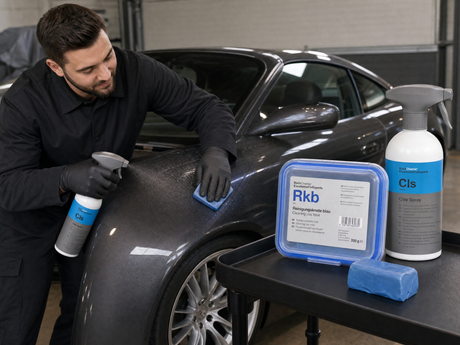
Polish removes what the clay reveals.
Koch-Chemie

Meguiars
HYBRID CERAMIC Synthetic Clay Kit Clay Bar
Synthetic Clay Pad + Ceramic Detailer + Microfiber Cloth — 1 Set
Message us on WhatsApp and we will put your kit together.
What is a clay sponge? A pad with a synthetic polymer layer that pulls embedded particles out of the clear coat just like detailing clay, only significantly faster and reusable. If you drop it on the ground, you rinse it off instead of throwing it away. The result depends solely on the lubricant.
A clay sponge for cars is a carrier pad with a thin layer of synthetic polymer that shears off particles protruding above the paint surface. Unlike detailing clay, this layer does not absorb the dirt but releases it when rinsed. This is where the reusability comes from, and it is also where the requirement for the underlying lubricant originates.
Practical tip from Detailing1: We regularly receive inquiries about a matte haze that appears on the hood in raking light after the first use. The cause is rarely the product and almost always stinginess with the lubricant. A clay sponge requires a thicker film than a clay bar because it lacks a putty-like mass into which a particle can disappear. Keep the surface wet enough so that the pad glides without resistance, and top it up as soon as you hear the first faint squeak. This sound is a warning signal, not proof that it is working.
A washed vehicle is clean. That doesn't mean it's smooth, and you only notice the difference with your hand.
Paint that has been outdoors for a year contains brake dust particles, industrial fallout from the air, residues of tree sap, and fine tar splatters from the roadside. These deposits do not lie on the surface but protrude from it. Shampoo cannot reach them because they are mechanically anchored rather than chemically bonded.
This is exactly where the polymer layer comes in. It is elastic enough to wrap around a protruding particle and firm enough to shear it off as it slides. In other words: the pad shaves off the tips sticking out of the clear coat. You'll know it's working when the surface becomes squeaky smooth without you having actually removed any material.
You can determine whether your paint surfaces need this in ten seconds. Pull a thin plastic bag over your fingers and run them over the dry, washed paint. The plastic intensifies the feel of every irregularity, and what feels like fine sandpaper is exactly the roughness that the clay sponge removes.
To clarify, here is what it cannot do. Embedded flash rust is dissolved chemically, not sheared off mechanically, and water spots containing lime sit inside the paint rather than on top of it. The complete process with all preliminary stages is under Paint Preparation; the chemical stage before that does not fall into this category.
The practical advantage becomes apparent after use. The layer does not trap dirt; it holds it firmly until water removes it. A pad that you rinse briefly after each panel and store dry after work will last you through multiple vehicles.
Both tools do the same job. They differ in how much negligence they allow you to get away with.
Detailing clay works with a built-in safety net. Every particle it picks up disappears inside the mass when you fold it, exposing a fresh surface. As long as you fold regularly, the collected dirt never comes back into contact with the paint. This tolerance is the reason why beginners rarely cause damage with clay.
The clay sponge does not have this net. What it shears off remains between the pad and the paint until the lubricant rinses it away. If you continue with too little film or too much pressure, a single grain of sand becomes a tool and pulls a fine streak. The community calls these traces "marring," and you can see them as a milky haze in raking light.
In exchange, you gain speed. Whereas with a clay bar you fold after every half square meter, you pull the pad in steady passes. A vehicle side that takes a good half hour with clay is done in about half that time with the pad.
The second advantage is dropping it. Clay that has been on the ground is beyond saving, because embedded sand cannot be removed from the soft mass. With the pad, you simply hold the soiled side under a jet of water and keep working.
For the decision, this means: If you decontaminate a vehicle once or twice a year and want to stay relaxed while doing it, detailing clay is a good choice. If you maintain several vehicles or work regularly, you save time and money with the pad, but you pay for it with the attention you must pay to the lubricant.
With this tool, there is exactly one lever that determines the difference between success and rework, and that is the amount of fluid on the surface.
A lubricant, known as "clay lube" in the scene, is a thin solution of water with surfactants and lubricating additives. It builds a cohesive film between the pad and the paint, in which sheared particles float instead of grinding. Practically speaking: the dirt floats up into the film and is taken away during the next rinse, instead of being dragged across the clear coat.
If this film breaks, the pad warns you immediately. It drags, it jerks, and it squeaks audibly on dry spots. If you continue pushing at this point, you will produce the very fine circular scratches that become visible as swirls in sunlight. The solution is never more pressure, but always more fluid.
A ready-made detailer works just as well as a highly diluted shampoo solution as a lubricant, as long as it doesn't foam like a wash cycle. Clear water alone is not enough because it lacks the lubricating component and the film breaks too quickly on vertical surfaces. Spraying and replenishing is cheaper than polishing.
A simple rule has proven effective for dosage: the surface must still shine moistly after the pass. Work in sections of about half a meter square, spray again before each section, and slide the pad without applying its own weight, guided only by your hand.
Temperature is part of the same calculation. On a surface in the sun, the film evaporates in under a minute, and you only notice it when the pad starts to grab. Shade and a surface that is cool to the touch are not about comfort, but the difference between clean work and an afternoon with the polishing machine.
All variants work with the same polymer layer. They differ in carrier shape, contact area, and the level of feedback they provide to your hand.
The flat pad is the basic form. The Koch-Chemie Clay Pad sits in the hand like a disc, distributes pressure evenly over the full contact surface, and is therefore the obvious choice for large horizontal surfaces like the roof, hood, and trunk lid. Wherever you can pull evenly, this design fully utilizes its time advantage.
The second design sits in a handle body. The Koch-Chemie Clay Scrubber clay sponge gives you more control over the contact pressure through the block and handles surfaces that are not flat. Rocker panels, wheel arch edges, and the zone behind the wheels are included here, i.e., exactly the areas with the highest particle density.
The hardness of the coating is also important for the selection. Finer layers work slower and are more forgiving; coarser ones remove sintered deposits faster but require a thicker lubricating film. For sensitive dark paints and freshly sealed vehicles, the finer variant is the safer choice.
Not every surface belongs under the pad. Matte paint, paint protection film, and wrapped surfaces are sensitive to shearing tools; here you stick to clay or avoid it altogether. Glass, on the other hand, tolerates the treatment without any problems and becomes noticeably smoother, which makes the wipers' work easier.
You can find related items in the neighboring categories. Soft applicator sponges for wax and sealant are under Applicators, washing and cleaning sponges under Sponges, and the entire group of hand-guided application and cleaning aids under Sponges and Applicators.
The clay sponge is not at the beginning of paint preparation, but in the middle. What happens before it helps determine the result.
First, wash thoroughly, including pre-wash and insect remover. Loose sand on the paint is the most common reason for scratches during claying because it becomes grit under the pad. After that comes the chemical round with iron and tar remover, because every particle that the chemicals have already dissolved does not end up under the polymer layer.
Then work panel by panel. Spray the area, place the pad flat, and guide it in straight overlapping passes—no circles. The pressure comes from the weight of your hand, not from your arm. If you notice that you are applying pressure, you are missing lubricant, not strength.
Between sections, rinse the pad briefly and look at the surface. Fine dark dots on it are normal and show that it is working. If a pebble has become lodged, remove it immediately, because this is exactly the grain that will pull a streak across your door in the end.
Check again with the plastic film over your fingers, this time on the dried surface. Anything that still feels rough gets a second pass with fresh lubricant. What is smooth is finished, and further claying brings nothing there but unnecessary contact.
Plan your time for the first time. For a medium-sized vehicle, you need half a day including washing and checking; the third time, it will take half a morning. This leap is normal and is due to the fact that you will then have the rhythm of spraying, pulling, and rinsing in your head.
A freshly clayed panel is smooth and at the same time unprotected. This state is an intermediate step, not a result.
In addition to dirt, the polymer layer removes everything that was on top of the paint. Wax, spray sealant, and residues of old preservation are largely gone after this process. Anyone who stops now and leaves the vehicle like this has an open clear coat that will absorb water spots and fallout unchecked.
Then there is the fine structure. Even with clean work, every shearing tool leaves a slight leveling of the surface, which becomes visible in raking light on dark paints. A quick round with a fine polish or an all-round product from Paint Preparation removes this and restores the depth of gloss.
If you don't polish, skip the step and go straight to protection. A spray sealant after drying takes twenty minutes and seals the surface again. This means for you: water beads off instead of staying in the freshly opened structure and leaving marks.
A simple rhythm is enough for the frequency. Once or twice a year, each time before a polish or a new sealant, meets the needs of most vehicles. If you park under trees or near train tracks, choose a shorter interval, and if you park your vehicle indoors, once a year is enough.
The only question remaining is which tool suits you. For large flat surfaces and a brisk pace, the Koch-Chemie Clay Pad is the right choice; for contoured sections and full control over pressure, the Koch-Chemie Clay Scrubber clay sponge. If you want maximum safety for the first time, start with detailing clay and switch as soon as you have mastered the process.
Too much choice in Claying tools? Get help picking:
Add Detailing1 as a preferred source on Google
Daniel von Detailing1 |

Daniel von Detailing1 |

Daniel von Detailing1 |

Daniel von Detailing1 |

Jasper von Detailing1 |

Daniel von Detailing1 |

Daniel von Detailing1 |

Jasper von Detailing1 |

Daniel von Detailing1 |

Daniel von Detailing1 |

Daniel von Detailing1 |

Daniel von Detailing1 |