

5 wheel zones that each need a different wheel brush
Jasper von Detailing1 |


Koch-Chemie
Interior Scrubber Interior Cleaning Pad

Koch-Chemie
Applicator Sponge for Plastic, Rubber & Leather Care

Koch-Chemie
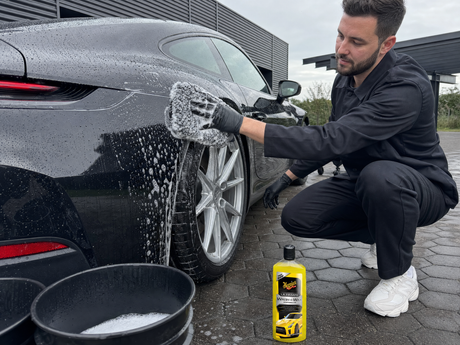
Shampoo, mitt and two buckets belong together.


Koch-Chemie
Applicator Sponge Microfibre Applicator Sponge

Koch-Chemie
Magic Eraser Specialist Sponge

Koch-Chemie
"Puck" Hand Polishing Sponge Applicator
Ergonomic applicator sponge for wax, leather & plastic care

Koch-Chemie
Application Pen Microfibre Applicator


GYEON
Q²M TireApplicator tyre applicator for tyre care

SONAX
PROFILINE CoatingApplicator Applicator Pads (Evolon®)
Premium applicator for precise coating application


Koch-Chemie × COLOURLOCK
COLOURLOCK "Cleaning & Application Sponge"
What belongs in this category? Application tools for car care. Sponges for washing and cleaning, applicator pads for wax, coating and interior, clay sponges for paint decontamination. The tool decides how evenly the product goes down and how much of it you actually use.
Sponges, applicators & cleaning pads are the tools where car care product meets paint, and an applicator is a pad made of microfibre, foam or microfibre non-woven that delivers a liquid or paste care product onto the surface in measured amounts. Sponges, by contrast, pick up dirt and carry it away, and clay sponges pull embedded particles out of the clear coat. All three types sit side by side in this category because they cover the same step: the contact between product and paint.
Detailing1's tip from the shop: If you get streaks or dark patches when applying wax, check your application against the specific product instructions. Take the product you're using, the surface and the applicator into account. Whether a pad may be dampened depends on the product and the manufacturer's instructions. While applying, keep an eye on how evenly the applicator spreads the product. Prep a coating applicator according to the specific product instructions too.
An applicator's construction and saturation affect how much product stays in the tool and how evenly it spreads across the panel.
The difference lies in the cell structure of the foam. Open-cell foam has interconnected cavities and acts like a sponge in the literal sense, drawing liquid deep inside. How a pad behaves with your care product depends on how it's actually built. So go by the product description and the product's instructions rather than deriving a usage rate from the material alone.
With microfibre sponges, compare weight, construction and intended use. GSM stands for grams per square metre and describes how much fibre mass sits on the surface. For the Koch-Chemie Allround Microfiber Sponge 410GSM Microfibre Sponge, check the intended use in the product description; the weight alone doesn't give you a specific absorbency or approval for your step.
At the other end is microfibre non-woven. The SONAX PROFILINE CoatingApplicator Applicator Pads (Evolon®) are made of split continuous filaments with an extremely dense, smooth surface. Check whether the pad is intended for your specific coating, and keep an eye on its saturation and how it spreads on the panel while you apply.
With a ceramic coating, base usage and tool choice on the specific product instructions. Factor the car's surface area and the applicator into your prep and check the applicator's saturation as you work. Use an application aid intended for the coating instead of working out a fixed coverage from the bottle size.
The pad's saturation also affects the spread. How the applicator behaves during application depends on its construction and the product you're using. So check it between sections and top up according to the specific instructions.
Three types share this category, and they do almost the opposite of each other: the sponge picks up dirt, the applicator pad releases product, the clay sponge pulls particles out.
Sponges work with water and cleaner. They take dirt off and hold onto it as long as they're in use. That's exactly what makes them strong in the interior and risky on fresh paint. Under Wash and cleaning sponges, you'll find the range from wash sponge to the Koch-Chemie Dirt Eraser Specialist Sponge made of melamine resin, which works like very fine sandpaper.
Applicator pads work dry or with product. Their job is dosing and evenness, not cleaning. The Koch-Chemie Applicator Sponge Microfibre Applicator Sponge is a single-use applicator for ceramic and glass coatings, and the GYEON Q²M TireApplicator tyre applicator for tyre care is shaped for the curved tyre sidewall. The full range is under Applicators.
Clay sponges are a case of their own. A layer of polymer rubber sits on a foam block and shears embedded particles out of the clear coat as soon as there's enough lubricant on the panel. The Koch-Chemie Clay Scrubber Sponge replaces the classic clay bar on large, flat panels. More on that under Claying tools.
The line between sponge and applicator isn't drawn by material but by job. Check the intended use of the specific microfibre sponge and keep wash and application tools apart; the material name alone doesn't clear it for both jobs. Once polish or wax residue is sitting in a wash sponge, it'll spread it over the whole body next time.
Labelled storage sounds over the top, but it's the easiest way to stick with it. Colour coding has worked well for us, one colour per job, from interior and paint to wheels and tyres. Once you've sorted it, you'll still grab the right pad after a two-month break.
Four features decide the quality of an applicator, and none of them is plastered across the packaging: core hardness, fibre build, edge shape and washability.
The core carries the pressure. Without a foam core you're pressing with your fingertips, and wherever your fingertips are, there's more product than next to them. A block with a firm foam core spreads the force over the whole face. The GYEON Q²M BlockApplicator EVO applicator block for coating is built for exactly that.
The fibre side decides the glide. Pile and construction have to suit the product you're using; fibre length alone doesn't tell you how much product a pad releases. According to GYEON, the GYEON Q²M MF Applicator EVO Microfibre Applicator has a plusher fabric than its predecessor and is right at home with spray sealants and quick detailers.
The edges are the underrated point. Rounded corners run over swage lines and edges; sharp seams catch there and leave a visible line with coatings. If a pad has a seam all the way round, deliberately work with the centre of the face, not the edge.
Washability decides the cost per use. Whether and how you can wash a microfibre applicator depends on the product used and the care instructions of the specific item. Fabric softener leaves a film on the fibre and destroys exactly the capillary action you bought the pad for. Non-woven applicator pads, on the other hand, are consumables: SONAX recommends binning them as soon as the product starts to cure inside.
One detail for the interior: the Koch-Chemie Application Pen Microfibre Applicator solves a problem every flat pad fails at. Air vent slats, seams on the seat bolster, the gap between dashboard and windscreen. Otherwise you'd be applying dressing with a finger wrapped in a cloth, which puts more product on the edge of the glass than in the seam.
Prep, section size and any levelling step follow the instructions of the wax, coating or care product you're using.
Prep the applicator according to the instructions of the product you're using. With coatings too, the specific product guidance and a suitable applicator are what count. If the application behaviour changes, check the manufacturer's notes instead of guessing the cause from the look alone.
Panel by panel means exactly that. Section size depends on the product's instructions and working conditions. Wet a whole side of the car in one go, and by the time you get to the back you're working on product that's already drying and fighting streaks there that don't show up at the front.
Use a cross-hatch motion. First horizontal passes with a slight overlap, then vertical ones over the same area. Two directions even out what one direction leaves as streaks, and in raking light you'll see straight away where a pass is missing.
Keep the pressure low. The pad should glide, not push. With coatings, the weight of your hand is enough; with wax on weathered paint, a bit more is fine. Press harder and you squeeze the product out of the pad instead of spreading it, and the panel goes blotchy.
The flash time is on the bottle and depends on temperature and humidity. Stick to the time window the manufacturer gives and the working conditions it's meant for. If the product instructions call for levelling, check the panel in raking light, turn the cloth after every panel and put it aside as soon as it feels greasy.
Plan your working time according to the specific product instructions and your prep. Practice can help you organise the steps; it doesn't give you a fixed number of minutes. The first round taking longer is just part of it.
A tool that stores dirt becomes a risk on paint, and that's behind most of the scratches customers show us after a hand wash.
The classic wash sponge is the best-known case. It picks up sand and holds it close to the surface, because its pores are shallow. On the next pass, the grit sits between sponge and clear coat. That's why we recommend the Koch-Chemie Car Care Wash Sponge for wheels, sills and wheel arches, not for the bonnet.
Clay sponges have a different limit. On flat panels they're quick; on edges, swage lines and badges they cut too hard, because the full face lands on a narrow line. There, the classic clay bar remains the finer tool, and plenty of lubricant is a must with both.
Melamine resin works purely mechanically. The Koch-Chemie Dirt Eraser Specialist Sponge lifts rubber scuffs and shoe marks off textured plastic, and it dulls glossy surfaces just as reliably. So it has no business on piano-black trim, screens or painted trim strips.
The third limit is contamination. Silicone-based tyre dressing migrates from the pad into every later application. We often see cases where a fresh sealant stayed blotchy, and in almost all of them the same applicator had been over the tyre sidewall first. One pad per product group costs less than a second round of sealing.
And then there's lifespan. An applicator with clogged fibres or torn foam no longer glides evenly. Hold it up to the light: if the surface shines instead of looking matte, there's cured product in it. Washing rarely helps at that point, and a new pad costs less than a round of polishing.
The choice comes down to three questions: what product are you applying, on what surface, and how often a year do you do it?
For paste and hard wax, a Foam applicator is the right answer; for spray sealant on paint, a microfibre applicator with a foam core. The Dr. Wack "A1" A1 "Applikations-Schwamm" Applicator sponge (microfibre) covers everyday use, and the matching products are under Car wax.
For a ceramic coating, use either a block with a firm core and a suede cloth as its face, or a non-woven pad with its own foam core. The GYEON Q²M BlockApplicator EVO applicator block for coating is that kind of block, with block and cloth replaceable separately. The SONAX PROFILINE CoatingApplicator Applicator Pads (Evolon®) come with non-woven and foam core built in and don't need a block.
In the interior, split by surface. The Koch-Chemie Interior Scrubber Interior Cleaning Pad works through fabric and textured plastic, and the SONAX PROFILINE Interior Sponge „Duo" Application Sponge has one soft and one grippy side for cleaning and dressing in one go. Suitable products are under Care products.
Keep a dedicated tool on the shelf for tyres. The GYEON Q²M TireApplicator tyre applicator for tyre care is curved, has a finger grip and keeps dressing off your fingers. It never goes near paint, and that alone makes a dedicated one worth it.
Decontamination comes before polishing and sealing. The Koch-Chemie Clay Scrubber Sponge takes most of the claying work off your hands on the roof, bonnet and doors, and for narrow areas a piece of classic clay stays alongside it.
To get started, add whichever tool is still missing for your specific job. Depending on the job, you might need a wash medium for the lower areas, an applicator suited to your care product or a pad for the interior. Whether you need more tools will become clear from your surfaces, the care product and how far you need to keep jobs separate.
Too much choice in Sponges, applicators & cleaning pads? Get help picking:
Jasper von Detailing1 |

Daniel von Detailing1 |

Daniel von Detailing1 |

Daniel von Detailing1 |

Daniel von Detailing1 |

Daniel von Detailing1 |

Daniel von Detailing1 |

Daniel von Detailing1 |

Daniel von Detailing1 |

Jasper von Detailing1 |

Daniel von Detailing1 |

Daniel von Detailing1 |