

Removing limescale spots from car windows without scratching the glass
Daniel von Detailing1 |


Koch-Chemie × COLOURLOCK
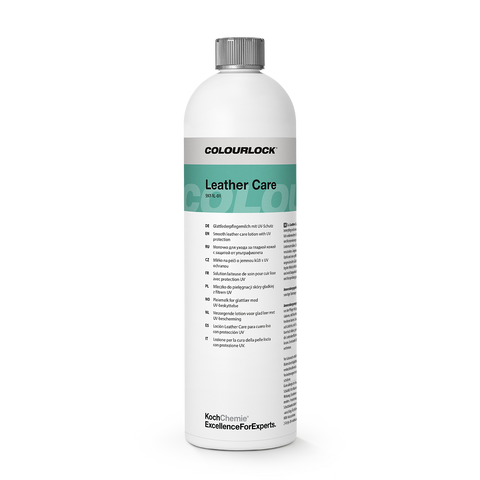
COLOURLOCK "Leather Care" Smooth Leather Care Milk with UV Protection
Nourishing lotion for smooth leather with UV protection
Koch-Chemie × COLOURLOCK
COLOURLOCK "Aniline Cream" Care for Open-Pore Smooth Leather
Premium care product for open-pored aniline leather
Koch-Chemie × COLOURLOCK
COLOURLOCK "Elephant Leather Oil" Natural care product for slightly hardened leather
Intensive care oil for dried out, hardened leather
Koch-Chemie × COLOURLOCK
COLOURLOCK "Leather Shoe Sole Oil" leather care for welted shoes with leather soles
Deep care for leather soles – more comfort and durability
What is COLOURLOCK care? The care line from the Lederzentrum (Leather Center) within the Koch-Chemie group, categorized by leather type: care milk with UV protection for pigmented smooth leather, cream for open-pored aniline leather, replenishing oil for hardened leather, and sole oil for welted shoes. For anyone who wants to preserve leather instead of replacing it at some point.
COLOURLOCK care is the value-preservation step after leather cleaning: products that return oils and moisture to the leather fibers before they become brittle. COLOURLOCK was created in 1995 at the Lederzentrum, the German specialist for leather restoration, and has been part of Koch-Chemie from Unna since 2023. Instead of a universal milk, the product range is divided by leather type — pigmented smooth leather, open-pored aniline leather, hardened leather, and leather soles each have their own formula.
Expert tip from Detailing1: The mistake we encounter most frequently in customer inquiries is greasy, shiny leather seats — and the cause is almost never the product, but the sequence of application. Applying care products to uncleaned leather seals skin oils and dirt under the film; this is exactly what causes that greasy shine. Therefore: always clean first, let it dry completely, then apply the care product thinly and remove the excess after 10 to 15 minutes using a microfiber cloth. A silicone-based cockpit spray is no substitute — it makes the seat surface slippery, attracts dust, and clogs the fine perforation holes of ventilated seats.
Anyone who recolors torn driver seats daily knows exactly which damages proper care could have prevented. That is the background of this category: COLOURLOCK was founded in 1995 as a brand of the Lederzentrum, which supplied restorers, saddleries, furniture restorers, and automotive manufacturers from Rosdorf near Göttingen with repair dyes and leather chemicals. Even museums preserve historical leather collections using products from this development lineage.
In 2023, Koch-Chemie from Unna acquired the Lederzentrum; since the end of 2024, development and bottling have been taking place at the Koch-Chemie facility. The formulas remained unchanged; the bottles now feature the white Koch-Chemie design with colored label stripes. For you, the main change is accessibility: the leather expertise gained over three decades is now available through the same distribution channels as the professional chemistry from Unna, which is found on the shelves of detailing shops throughout the DACH region — and in our shop, both worlds stand side by side.
The difference from classic car care brands is evident in their specialization. A universal milk must work on every seat and therefore remains a compromise. COLOURLOCK formulates based on repair practice: separate products for pigmented and open-pored leather, a dedicated oil for hardened surfaces, and even one specifically for leather soles. We often receive inquiries about cracked seat bolsters where two care rounds per year would have delayed the need for repair by years — and this category fills exactly that gap.
The flagship product for car interiors is COLOURLOCK "Leather Care": an oil-in-water emulsion for pigmented smooth leather — tiny oil droplets enclosed by a water phase that carries them into the fine cracks of the color layer. This means for you: the milk is absorbed rather than sitting on top as a greasy film, and the leather remains matte, just like from the factory. The incorporated UV absorbers protect the color pigments from fading. Available in 100 ml for a trial and 1000 ml / 1 liter for those who care for both their car and furniture at the same rhythm — even the small bottle is enough for multiple rounds on a complete set of seats.
The COLOURLOCK "Aniline Cream" works in a fundamentally different way. Open-pored aniline leather has no opaque pigment layer and absorbs liquids like a sponge — a water-rich milk would dry unevenly and create stains. The cream is therefore consciously formulated with a low water content: it absorbs into the pores via capillary action, builds a stain- and moisture-repellent barrier, and leaves the matte, warm character of the leather untouched. The rule here is: less is more, and only treat the leather as often as it truly needs.
For leather where standard care comes too late, there is COLOURLOCK "Elephant Leather Oil": a purely synthetic, replenishing oil whose long-chain fats act like a lubricant between the dried-out collagen fibers — the leather creases again instead of breaking. Typical candidates are vintage car interiors, motorcycle seats, old furniture, and work leather. Finally, COLOURLOCK "Leather Shoe Sole Oil" keeps the soles of welted shoes flexible — a niche that hardly any other manufacturer serves at all.
Within this category, we also list each application area as a separate sub-page with in-depth advice:
The water drop test clarifies the most important question in 30 seconds: place a drop of water on an inconspicuous area. If the drop stays on the surface, the leather is pigmented — an opaque color layer protects it, and "Leather Care" is the right choice. If the drop is absorbed and darkens the spot, you are looking at open-pored leather, and only "Aniline Cream" can be used. In cars, the answer is usually clear: practically all mass-produced car seats — technical literature mentions around 99 percent — are finished with pigments. You are more likely to find open-pored leather on designer furniture, in bespoke vehicles, and on luxury handbags.
From the Detailing1 daily routine, here is a negative example of this confusion: an aniline sofa treated with ordinary care milk — it left behind dark clouds that could not be removed because the emulsion had soaked into the open pores. The water drop test beforehand would have prevented it. Synthetic leather, on the other hand, needs no replenishment: it has no leather fiber that could absorb oil. Regular cleaning is sufficient; if protection is needed, a specific synthetic leather sealant should be used instead.
Equally important is what care products cannot do. Faded or worn-through leather will not have its color restored by care milk, nor will it remove blue jeans dye transfer on light-colored seats — for that, there are the color refreshers from COLOURLOCK, which specifically add pigments back to the material. If the leather already has cracks or brittle areas, no care product will help: in that case, the restoration begins with pretreatment & repair by COLOURLOCK, which prepares hardened material for repair.
The process is identical for all products in this category and takes about 30 minutes for a complete set of seats the first time: clean the leather, let it dry completely, apply the care product thinly with a cloth or applicator, let it absorb, and remove the excess. Immediately after application, the surface often looks duller than expected — that is the film that has not yet absorbed, and it is part of the process. After removal, you are left with a matte, uniform finish.
When it comes to frequency, a nuanced view is worthwhile: the driver seat and steering wheel endure friction, skin oils, and sweat, so they should be cleaned and cared for about every three months; the back seat can go six to twelve months, and furniture leather requires one or two rounds per year. In our experience, for a vehicle parked permanently in a garage, half the frequency is often enough — without UV exposure and temperature fluctuations, leather ages noticeably slower. Leather soles need oiling every one to two months depending on how often they are worn, while aniline leather only needs care when it feels dry or shows the first light-colored spots.
The time of year also belongs in the maintenance plan. In summer, UV radiation and interior heat work together: they drive out residual moisture and oils from the leather, the fibers shrink, and the color fades — convertible leather and furniture by a south-facing window are hit the hardest. In winter, the picture changes: dry heating air silently extracts moisture, and on leather shoes, road salt has a dual effect because it draws water out of the sole leather, and the salt crystals act like fine blades in the fiber structure while walking. By scheduling your care rounds for spring and autumn, you catch both peak stress periods before they leave a mark.
Three tips determine the result. Work only paper-thin on the steering wheel — a heavy care film makes the rim slippery. With "Elephant Leather Oil," proceed in several sparing rounds over a few days rather than flooding it once: the leather can only absorb what its fibers can currently hold. And with the sole oil, avoid the seams — otherwise, the oil can creep into the welt stitching and potentially loosen the glue.
An honest assessment: for a three-year-old car with pigmented seats in good condition, universal leather care from major car care brands works perfectly fine — products from Sonax or Dr. Wack consistently perform well in laboratory tests for cleaning power. If your situation is like this, that is quite enough.
COLOURLOCK takes over as soon as the case deviates from the standard: open-pored aniline leather that reacts to water-rich milk by staining. Hardened leather in a classic car that needs true replenishment rather than surface cosmetics. Welted shoes for which there is no product on the car care shelf. In leather forums and detailing communities, the brand has been considered the benchmark against which others are measured for years — mainly because the products consistently leave the leather matte, just as it came from the factory. A greasy shine is the most visible sign of incorrect care in the scene; this is exactly why matting is the core philosophy here.
The distinction from home remedies is even stricter. Olive oil, udder cream, and body lotion appear in every forum as insider tips, but they cause damage in the medium term: cooking oils do not absorb; instead, they resinify on the surface, turn rancid, and darken uncontrollably — once it is in the fibers, even a professional cannot remove it. Skin creams are designed for living skin, not for tanned material with a synthetic finish; their fat film clogs the pores and accelerates the loss of plasticizers in the coating. A leather care product is designed to remain oxidation-stable — that distinguishes it from everything in your kitchen.
Perhaps the most surprising truth of this category is that a new car does not need care milk yet. In the first three years or so, automotive leather is optimally replenished from the factory — a milk can barely be absorbed and tends to make the surface sticky instead. What really threatens young leather is abrasion and blue jeans dye transfer, and the sealant & impregnation from COLOURLOCK helps against that. After about three years, the care cycle with "Leather Care" begins, and if leather has become stiff after many years, "Elephant Leather Oil" takes over.
If you do not want to put together individual products, you will find cleaners, care products, and accessories coordinated with one another in the sets from COLOURLOCK — sorted by these very leather ages, from the new leather set to the classic car set. And if your concern is not nutrition but water protection — outdoor leather, convertible top edges, heavily worn shoes — the care oil in Leather Oil & Impregnation from COLOURLOCK combines both in one step: it nourishes and impregnates at the same time.
Finally, a note that makes the biggest difference in our consultations: leather does not age uniformly. The driver seat's entry bolster receives friction, skin oils, and weight with every entry and exit, causing it to age several times faster than the back seat. Care for it twice as often as the rest — then after ten years, the seat will still look like a cohesive whole rather than two halves of different ages.
Too much choice in Care from COLOURLOCK? Get help picking:
Daniel von Detailing1 |

Daniel von Detailing1 |

Daniel von Detailing1 |

Daniel von Detailing1 |

Jasper von Detailing1 |

Daniel von Detailing1 |

Daniel von Detailing1 |

Daniel von Detailing1 |

Jasper von Detailing1 |

Jasper von Detailing1 |

Daniel von Detailing1 |

Daniel von Detailing1 |