



Removing limescale spots from car windows without scratching the glass
Daniel von Detailing1 |


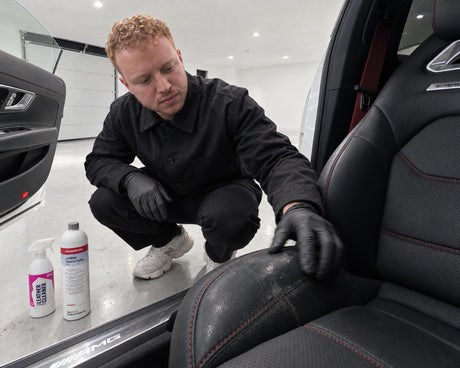
The mild cleaner takes off skin oils, Strong stays for denim dye.
Koch-Chemie × COLOURLOCK
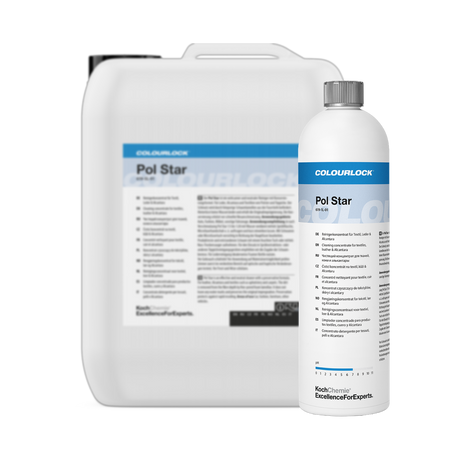
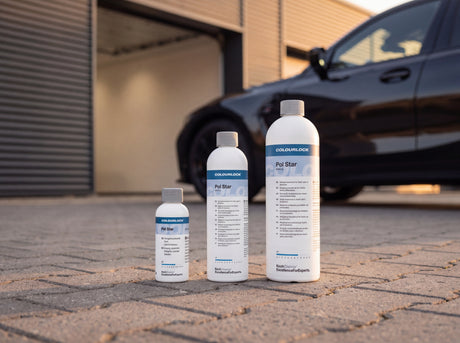
COLOURLOCK "Pol Star" cleaner concentrate for fabric, leather & Alcantara
pH-neutral cleaner concentrate for fabric, Alcantara & smooth leather
Koch-Chemie × COLOURLOCK
COLOURLOCK "Leather Cleaner" (Mild) — cleaner for normally soiled pigmented smooth leather
Gentle daily leather cleaning and care
Koch-Chemie × COLOURLOCK
COLOURLOCK "Degreaser" Solvent-Free Leather Degreaser for Surface Prep on All Leather Types
Solvent-free degreaser for optimal leather repair preparation


Koch-Chemie × COLOURLOCK
COLOURLOCK "Smooth Leather Care" Set (care kit for smooth leather aged 3 years and up)
Leather care for older leather for suppleness and protection
Koch-Chemie × COLOURLOCK
COLOURLOCK "Leather Cleaner" (Strong) cleaner for heavily soiled, surface-pigmented smooth leather
Powerful intensive cleaning for heavily soiled leather


Koch-Chemie × COLOURLOCK
COLOURLOCK "Leather Steering Wheel" Set (leather repair kit for black steering wheels)
Repair leather steering wheel with OEM finish.


SONAX
PROFILINE LeatherCleaner (foam cleaner)
LeatherCleaner — Professional Leather Cleaner (Foam Cleaner)
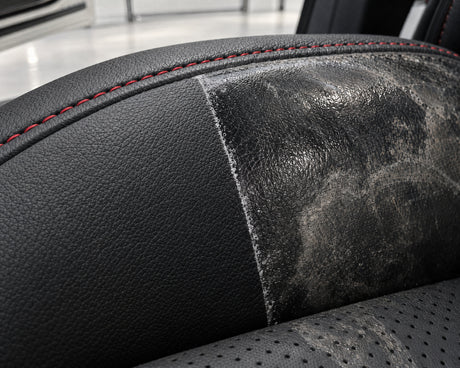
Two passes mild, only then the strong step. That keeps the grain intact.
Koch-Chemie × COLOURLOCK
COLOURLOCK "Aniline & Nubuck Cleaner" Gentle cleaner for all open-pore smooth leathers and nubuck
Gentle cleaning and safe deep conditioning for aniline and nubuck
Koch-Chemie × COLOURLOCK
COLOURLOCK "GLD Solvent" Strong Remover for Stubborn Discolouration on Smooth Leather
Stain and Color Transfer Remover for Leather


Koch-Chemie × COLOURLOCK
COLOURLOCK "New Leather Care" Set (care set for new smooth leather up to 3 years)
Protect new leather with care and sealing, just like the factory
Koch-Chemie × THE FINISHER
THE FINISHER "LeatherTexClean" Leather & Textile Cleaner
Mild cleaner for smooth leather and textile surfaces
Koch-Chemie × COLOURLOCK
COLOURLOCK "Stain Remover" leather stain and wax remover
Reliably remove stains and wax residue from leather
What does a leather cleaner do? It lifts body oils, dirt and colour transfer off the pigmented topcoat of your seat without softening it. Regular interior cleaners are too surfactant-heavy for that and pull colour. There are mild versions for routine work and strong ones for dye transfer from jeans. At Detailing1 the range centres on COLOURLOCK and SONAX.
Leather cleaners are pH-adjusted, low-surfactant cleaners made for the finish on automotive leather — the thin pigmented topcoat that carries the colour and the wear resistance. They pull body oils, dust and colour transfer out of the grain without softening the binder that holds the finish together. The difference from an all-purpose cleaner shows up on the cloth: if it picks up colour, the product was too aggressive.
Day-to-day from Detailing1: What we see most often isn't the wrong product, it's the wrong brush. Plenty of people reach for stiff bristles because the seat looks stubborn. But stiff bristles polish the grain smooth, and once a spot goes smooth it turns shiny and plasticky — damage you can't undo. Grab a soft leather brush with natural bristles and work with no pressure. The cleaning comes from the foam and the dwell time, not from scrubbing. If one pass isn't enough, do two mild ones rather than a single hard one.
Almost everything you take for leather in a car is pigmented smooth leather — a hide with a topcoat of pigment, binder and finish on top. The cleaner always meets this layer first.
That's good news, because the topcoat is water-repellent. So a cleaner doesn't soak into the leather — it stays up top where the dirt sits. That's exactly why the foam method works: the foam sits on the surface, breaks down the film and comes off again with the dirt.
The bad news is how sensitive that same layer is to strong surfactants and high pH. Both start to soften the binder that holds the pigments. You see it on the cleaning cloth as it takes on colour — at that point you're taking off colour, not dirt. Once a spot goes matt, only re-dyeing brings it back.
That's why leather cleaners are set to a near-neutral pH and run on fewer, milder surfactants than an interior cleaner. What that means for you: they need a bit more dwell time and more passes, but the colour stays where it belongs.
One detail that explains the choice of material: automotive leather is chrome-tanned, which makes it far more resistant to heat and moisture than the vegetable-tanned leather from the furniture world. Furniture conditioners are tuned for that other material and are often too rich in oils for a car — they leave a film that never soaks in. So don't reach for a saddle-soap or furniture product on the seat, even though both go by the name leather.
The reason body oils still have to come off is what they do. They creep slowly into the finish and soften the binder — at the contact points the seat first goes shiny, then tacky, then brittle. So cleaning is protecting the substance, not cosmetics.
The range carries two strengths side by side, and the choice follows what the dirt looks like, not how long it's been.
The mild cleaner is the one for the normal case: dust, light body oils, fingerprints. It comes out two to four times a year and leaves the finish untouched. The GYEON Q²M Leather Cleaner Natural (mild) and the COLOURLOCK „Leather Cleaner" (Mild) cover this level.
The strong cleaner is for what the mild one leaves behind: denim dye on light seats, body oils worked into the wheel, a film of nicotine. It runs a higher surfactant load and belongs on spots, not as your default. The GYEON Q²M Leather Cleaner Strong sits in this group.
The honest read on that: every pass with a strong cleaner costs a little finish. On light leather it's still the right call, because the alternative — dye that's worked in — stays for good and only re-dyeing fixes it. On dark leather you'll rarely, if ever, need the strong grade.
There's a practical middle road between the two grades: run the mild cleaner twice in a row. Two mild passes lift a surprising amount of what a single one leaves behind, and cost no finish. Only when the second pass moves nothing more is the strong grade justified — and then on the spot itself, not across the whole seat.
Foam cleaners are the third format and the safest route for beginners, because the foam makes the dose visible. The SONAX PROFILINE LeatherCleaner (foam cleaner) is the best-stocked item we carry in this group.
Before any cleaning pass comes working out the leather type, and it takes ten seconds.
The water-drop test settles it. Put a drop on a hidden spot, say the underside of the seat. If it beads or just sits there, you've got pigmented leather with an intact topcoat and a free choice of product. If it soaks in and the spot darkens, it's aniline or an open-pored leather.
Aniline leather is dyed all the way through and carries little to no topcoat. It feels warmer, takes on moisture straight away and keeps every edge a normal cleaner leaves behind. The COLOURLOCK „Aniline & Nubuck Cleaner" (gentle cleaner) is the only way to work here without a water ring.
Nubuck and Alcantara are napped. Rub them wet and the raised fibres lie flat and go shiny — the same effect as too hard a brush on smooth leather, just faster. Here you work with minimal moisture and brush the nap back up afterwards.
Faux leather and vinyl don't need a leather cleaner in the strict sense, because there's no hide to dry out. For those surfaces there's the Koch-Chemie Allround Leather Cleaner „Alc" for vinyl and faux leather, which covers both materials.
The routine is always the same, and the order heads off most mistakes.
First you vacuum. Sand and crumbs in the seams act like sandpaper on the finish once you start brushing. A soft detailing brush lifts them out of the seam, the vac picks them up. On perforated, ventilated seats you vacuum rather than push moisture into the holes — whatever runs in there doesn't come back out.
Then you put the cleaner on a slightly damp sponge and work it into a foam. Never spray straight onto the seat — the product runs into the seams, pools there and lightens the thread over time. You lay the foam on across the surface and it stays up top where the dirt sits.
With the soft brush you work the foam into the grain, no pressure, in small circles. Work in sections of about half a seat so nothing dries on. Cleaner that dries on leaves an edge that makes more work on the next pass than the original dirt did.
Then you wipe off with a clean, just-damp microfibre. Check the cloth: if it takes on colour, the cleaner is too strong for this leather and you drop to the milder grade. If it only goes grey, you're on the right track. Swap the cloth the moment it's saturated, otherwise you're just moving the loosened dirt around.
To finish, let it dry and condition it. A cleaned seat with no re-oiling afterwards ends up barer than before, because the clean took the last of the previous care off with it.
Our cleaner range is smaller than the conditioner range, but graded more finely.
COLOURLOCK comes out of professional leather repair and brings that grading with it. That's what gives you the three-way split into mild, strong and aniline — a spread you rarely see in the mass market and one that makes the difference day-to-day, because you're not going at three different leather types with one compromise product.
SONAX covers the mid-price segment, with a focus on foam cleaners for easy dosing. On top of that, the SONAX PROFILINE WaterSpot Remover is a specialist for a problem no normal cleaner solves.
GYEON splits its range cleanly into mild and strong; CarPro, Koch-Chemie and Meguiar's each add one or two items. For cars with a mix of leather and cloth, the THE FINISHER „LeatherTexClean" leather-and-textile cleaner is a product that covers both materials — handy on seats with leather bolsters and cloth centre panels.
The price range sits close together, because leather cleaners almost always come in 250 or 500 ml bottles. Usage is low: for a full interior with leather seats, reckon on 30 to 60 ml depending on how dirty it is. A 500 ml bottle lasts several years that way, and the choice between two products comes down to leather type rather than price.
A few items in the range are care sets that bundle cleaner and conditioner together. For getting started they're the easier pick, because the match between the two steps is already sorted.
Three kinds of soiling keep coming up for us, and each one needs a different approach.
Denim dye is the most common case on light leather. The dye migrates into the finish through friction and moisture. Fresh, the strong cleaner lifts it well. After a year or two it's worked in so deep that cleaning no longer cuts it and only a colour refresh helps. So if you drive light leather, clean the seating surfaces more often than the rest of the car calls for.
A nicotine film is stubborn and sits everywhere, not just on the seats. The strong cleaner shifts it, but it wants several mild passes rather than one aggressive one — and the job has to take in the door cards, the wheel and the headliner, or the smell comes back out of the surfaces you skipped.
Water spots form when moisture dries on absorbent leather and leaves dissolved salts at the edge. Dabbing at the spot usually just makes a second ring. What works is treating the whole panel evenly, out past the next seam.
On a used-car buy several of these cases often land together, and then an order pays off. Mild cleaner over everything first, to take off the base layer and see what actually stays. Whatever's still visible after that gets the strong treatment on the spot. Start the other way round and you run the strong grade over the whole cabin and cost finish in places that never needed it.
A fourth case is ballpoint pen and colour transfer from handbags. Both are solvent-based and barely budge with water-based leather cleaners. Speed is everything here: fresh, your odds are good; after weeks, near zero. Test any solvent on a hidden spot first, because it softens the finish just as readily as the pen paste.
When the re-oiling comes due after cleaning, you'll find it under Leather care. Working out the leather type and the overview of both steps sit under Leather, and for cloth seats the way leads to Fabric & upholstery.
Too much choice in Leather cleaner? Get help picking:
Daniel von Detailing1 |

Daniel von Detailing1 |

Daniel von Detailing1 |

Daniel von Detailing1 |

Jasper von Detailing1 |

Daniel von Detailing1 |

Daniel von Detailing1 |

Daniel von Detailing1 |

Jasper von Detailing1 |

Jasper von Detailing1 |

Daniel von Detailing1 |

Daniel von Detailing1 |