Cleaning an Alcantara steering wheel: grippy again, not greasy
Daniel von Detailing1 |


Koch-Chemie × COLOURLOCK
COLOURLOCK "Leather Shield" Care Product for New Leather to Protect Against Wear
Protect leather from abrasion and maintain its matte finish


Koch-Chemie
Allround Leather Sealant "Als" Vinyl, Faux-Leather & Genuine-Leather Sealant (Marine-Linie)
Reliable Protection for Vinyl and Leather Surfaces for Boats
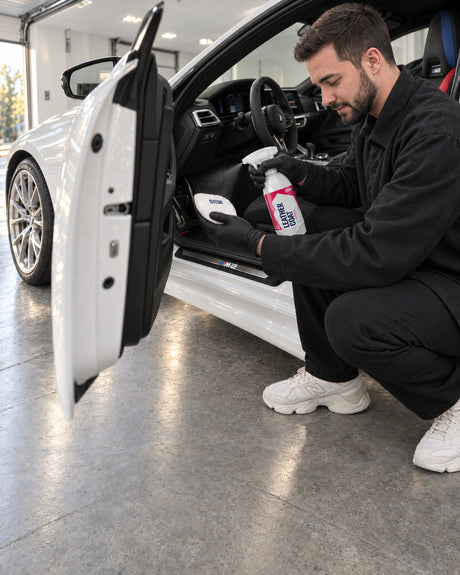
GYEON Q² LeatherCoat (REDEFINED) seals cleaned leather with an SiO₂ layer.


GYEON
Q² LeatherCoat (REDEFINED) Ceramic-Based Leather Care
Leather Care and Sealant – Ceramic Protection and Care in One


GYEON
Q² LeatherShield EVO Ceramic Leather Coating Leather Ceramic Sealant
Ceramic coating for car leather – protects against stains and wear


CarPro
CQUARTZ "Leather" 2.0 Leather Sealant
Premium Leather Sealant for Optimal Protection
A leather sealant protects an intact surface that is approved for it. What decides is the leather finish, its condition and the product instructions. It doesn't repair discolouration that has already soaked in or damaged colour layers, and a re-oiling leather care product does a different job.
Leather sealant here means surface protection for suitable leather surfaces. The leather finish, meaning the visible coating or dye, helps decide which product fits. Cleaning, caring, repairing and sealing are separate jobs. That's why the choice doesn't start with the catchiest product name but with the material, the condition of the surface and the protection you want day to day. The specific approval counts for more than a generic product description.
Detailing1's tip from the shop: Before you buy, check the material designation of the seat or item and then the specific product approval. A hidden compatibility test helps with colour and feel. It doesn't, however, replace a clear identification of the leather or the manufacturer's instructions.
A leather sealant makes sense when an intact, explicitly approved surface is to be protected in daily use and kept clean more easily. It goes on after suitable cleaning and is meant to support the surface in future use. Anything already visible as a stain, dye transfer or wear spot won't disappear retroactively with this step.
So the sequence starts with a sober assessment. Loose dirt and unsuitable care residue don't belong under a new protective layer. At the same time, not every cleaner suits every leather. Open-pore or buffed surfaces need different treatment from pigmented automotive leather. Blanket heavy degreasing is therefore no safe instruction for the whole category.
Re-oiling care isn't the same as surface protection either. Re-oiling is meant to give leather intended for it nourishing ingredients. A sealant, on the other hand, is chosen for its protective job. Whether both steps are intended within one system follows from the respective product and item details. A general order such as oil first, then sealant can't be derived from that.
If you want to seal leather, define the goal clearly: should an intact seat surface be protected against further wear, or does the material need cleaning, re-oiling or repair? You'll find the bigger choice between these routes under Leather & faux leather. That way a care problem doesn't end up with a pure protection product by mistake.
A sealant doesn't make leather indestructible either. Liquids, clothing and mechanical wear still matter, and spills still have to be removed in a way that suits the material. The benefit lies in preventive surface protection within the confirmed approval, not in a guarantee against every bit of soiling, wear or later colour change.
Ceramic leather coatings belong to the protection family but call for a closer check of material, prep, application and subsequent curing according to the specific manufacturer's instructions. The term therefore doesn't describe an automatically better choice for every leather. It marks a product type of its own whose application and limits mustn't be carried over to other leather sealants.
For a deeper dive there's the subcategory Ceramic coating for leather. There the narrower selection of ceramic protection products takes centre stage. On this page, the key distinction is enough: first clarify whether the specific leather is approved for the coating, then follow the particular prep and curing of the product you've chosen.
A product name alone doesn't answer these questions. The shop title of LeatherCoat includes the addition ceramic-based. We don't take that as a general statement about the formula or equate it with a curing ceramic coating. What counts is the current manufacturer description, the material range it names and the application it explains.
Visible beading would also only be a single observation and not complete proof of abrasion resistance or durability. Likewise, an unchanged feel on its own doesn't show that a product isn't working. A leather sealant isn't necessarily meant to create a noticeable film. It may only be judged within the job the manufacturer describes, not by a single test you've made up yourself.
That makes the choice simpler: if you're looking for general surface protection and one of the approvals listed here fits, compare material and application. If you're explicitly looking for a ceramic leather coating, switch to the matching subcategory. This separation stops information about curing, resistance or application from wandering from one product to the whole collection.
The leather finish, meaning the visible surface treatment, decides whether a sealant sits evenly or may be unsuitable for the material. With pigmented or surface-dyed smooth leather, a protective colour layer sits on top of the leather. Many products for car interiors are aimed at such coated surfaces, but the respective approval still applies.
Aniline leather is also smooth leather, but it has open pores and reacts more sensitively to liquid. That's why the word smooth leather in a general description isn't enough as an approval. Nubuck and velour have a buffed surface; instructions for coated smooth leather can't be carried over to them either. These materials need products and care routes explicitly intended for them.
The name nappa doesn't decide things on its own either. It can cover different surfaces, while the product approval may be worded more narrowly or differently. GYEON names LeatherCoat for selected automotive leathers, including semi-aniline and nappa. That isn't a blanket approval for untreated aniline leather, every nappa leather or suede.
With faux leather and vinyl, the guidance of the seat, furniture or vehicle manufacturer comes into play as well. A product can name such materials in its own approval without being suitable for every covering. You'll find the material-specific choice under Faux leather sealant. Re-oiling waterproofing oil, in turn, has its own, narrower job under Leather waterproofing.
Unclear mixed materials deserve special attention. On a car seat, the seating surface, side bolster and back can be built up differently. So check not just the model name but the material details for the actual area you're treating. If it can't be identified with certainty, holding back makes more sense than deriving an approval from a similar product name.
According to manufacturer guidance, a drop of water on a hidden spot gives a hint about how absorbent the surface is. That alone doesn't give you a free choice of product. On valuable, coated or already damaged surfaces it doesn't replace a material designation or a specific product approval. Care instructions for the specific item and trim data have to match. If the classification stays unclear, have it checked by an expert before coating.
Once the material approval is settled, the specific instructions decide how thinly you apply, which residue you remove and when you check. A shared basic routine is only possible as a guide: clean the surface to suit the material, let it dry completely, test compatibility on a hidden spot and work the protection product in evenly. Amounts, waiting times and finishing stay product-specific.
Removing residue in particular shows why general instructions fall short. For the Allround Leather Sealant, Koch-Chemie calls for removing residue after application and buffing with a soft viscose cloth. For LeatherCoat, GYEON describes even application and wiping off visible residue. Neither statement adds up to always buff or never buff.
Work on a manageable area so you can keep the application and any visible residue under control. That's a hands-on guide, not an extra time or quantity figure. For seams, perforations and transitions, the specific instructions apply as well. Product pooling in recesses is no sign of better protection.
A clean, soft cloth helps with controlled application, but the cloth material follows the product's instructions. Koch-Chemie explicitly names a soft viscose cloth. With GYEON, the individual instructions apply. Any old cloth with unknown residue is unsuitable for both jobs.
After application, don't rush to go over the treated surface with another care product or sealant. Follow the product-specific guidance on drying or curing. Because the products researched use different processes, there's no made-up shared waiting time here. On freshly repaired or re-dyed leather, the guidance of the repair system used applies as well.
The two products listed here differ mainly in the approved material, the intended use and how the surface is finished off. So the comparison doesn't start with a ranking. It shows which product description fits the surface you have and the way you want to work.
Allround Leather Sealant "Als" Vinyl, Kunstleder- und Echtlederversiegelung (Marine-Linie) is intended, according to Koch-Chemie, for vinyl, faux leather and surface-dyed smooth leather in the marine sector. That gives it a scope of use across several materials.
Q² LeatherCoat (REDEFINED) Lederpflege auf Keramik-Basis is aimed by GYEON at named automotive leathers, including semi-aniline and nappa. For the protection period, the manufacturer quotes more than three months, explicitly depending on use and conditions. That statement is no guarantee and no value for the whole category.
If several material types are to be treated within the use the manufacturer describes, the broader approval of the Allround Leather Sealant may be relevant. If it's about an automotive leather GYEON names and its way of working suits you, LeatherCoat is the obvious option to compare. In both cases, checking the material matters more than the brand name.
No reliable, current comparison test of both products under the same conditions is available for this advice. So there's no test winner here, no percentage superiority and no performance claim derived from reviews. The choice is based on manufacturer approvals and differences in application. That's less spectacular than a ranking, but it tells you more about the right use.
The shop designations care or ceramic-based don't automatically change who does what either. Check which effect and application each manufacturer actually describes. That way you avoid filing LeatherCoat as a re-oiling leather care product or crediting the Allround Leather Sealant with the properties of a ceramic coating.
A sealant only preserves what's there as a sound surface, and it replaces neither colour correction nor the repair of a finish that's already damaged. Cracks, sticky spots, peeling coatings or a visible base material call for a condition assessment first. A protective film can't add missing material or reattach a loose colour layer.
Dye transfer that has already soaked in doesn't simply belong under a sealant either. First check whether it can be cleaned off in a way that suits the material or whether the surface is already damaged. Overly aggressive cleaning attempts can put further strain on the finish. If a repair is needed, the repair system decides the prep and the later protection.
For newly dyed or repaired surfaces, there's no general waiting time that fits every system. Follow the specific supplier's guidance on colour, sealant and when the surface can be used. Only once the new surface is sound and approved for the protection product does an additional leather sealant even become the next topic.
On the steering wheel in particular, a dry, even grip counts. If a coating changes the feel unexpectedly, don't blindly apply another layer. Stop, check product, material and application, and sort out the correction using the respective instructions or a specialist. A universal solvent or a blanket removal method would be risky here.
Preservation and repair stay separate even when the damage looks small. A sealant can limit wear on a sound surface, but it doesn't stabilise a coating that has come loose. The decision point stays clear: protection is an option for intact, suitable surfaces; repair is planned according to condition and the system used.
That keeps the buying decision clear: with an intact, known and approved surface, you compare protection job and application. With open-pore, buffed, unknown or damaged material, you first work out the right care or repair route. In the end, material approval and product-specific application matter more than the catchiest product name.
Too much choice in Leather sealant? Get help picking:
Add Detailing1 as a preferred source on GoogleA leather sealant is a surface protection product for approved, intact leather surfaces. It is selected based on the leather finish, condition, and protective requirements and is applied after appropriate cleaning. It does not repair existing stains, color abrasion, or damage; re-greasing leather care products serve a different purpose in the care system.
Use a clean, soft cloth according to the respective product instructions. Koch-Chemie specifies a soft viscose cloth for buffing; GYEON requires the removal of visible residue. Cloths containing residues of cleaners, polishes, or other care products can compromise a controlled application. Therefore, the specific instructions determine the choice of cloth and the method of residue removal.
These terms are not used as fixed opposites by all manufacturers. The decisive factors are the stated protective task, material approval, and the application of the specific product. A leather sealant or protector can provide surface protection, but it does not replace proper cleaning, re-greasing care, or the repair of damaged leather color.
Only if the specific product explicitly approves synthetic leather or vinyl. Approval for genuine leather cannot be applied to synthetic leather. Additionally, check the guidelines provided by the seat, furniture, or vehicle manufacturer for the actual surface being treated. If the material designation is unclear, approval remains unverified; the name "leather care" is not sufficient as proof.
Do not apply another layer immediately. First, check if the product, material, application amount, and residue removal align with the instructions. For safety-relevant surfaces such as the steering wheel, the grip should remain dry and even. Correction or removal should only be performed according to product specifications or by a professional shop.
There is no universal interval for all leathers and products. Care requirements, cleaning, and renewal of protection are separate decisions. For GYEON Q² LeatherCoat (REDEFINED) ceramic-based leather care, the manufacturer specifies more than three months, depending on usage and conditions. For other products, their own instructions apply, along with the condition and wear of the surface.
Daniel von Detailing1 |

Daniel von Detailing1 |

Daniel von Detailing1 |

Daniel von Detailing1 |

Daniel von Detailing1 |

Daniel von Detailing1 |

Daniel von Detailing1 |

Daniel von Detailing1 |

Daniel von Detailing1 |

Daniel von Detailing1 |

Daniel von Detailing1 |

Daniel von Detailing1 |