

A warm sticker takes its adhesive with it when it leaves the paint
The dealer sticker on the tailgate, the old badge on the wing, the last bit of tape from moving house. Almost everyone starts with a fingernail. Two minutes later the sticker is half off and the rest sits on the paint as a grey rim of glue. That's when the question we get more than any other comes up: what do I go at it with without damaging the paint?
If you want to remove a sticker from your car, warm it with a hairdryer to 40 to 60°C first and peel it off flat. Whatever adhesive is left behind, an adhesive remover dissolves. Finally, you wash the spot again and put fresh protection on it.
Peeled off warm, the sticker takes its adhesive with it
A sticker comes off cleanest when its adhesive is warm and soft: at 40 to 60°C the glue stays on the backing instead of on the paint.
It all comes down to the adhesive itself. Stickers and vinyl carry a pressure-sensitive adhesive that stays tacky even at room temperature. Warm it up and it softens and lets go of the paint. Peel it cold and the adhesive tears in two, leaving one half on the paint. Peeled warm, it holds together on the backing and comes away with the sticker.
This is the one move that decides how the rest of the job goes: heat first, then a flat pulling angle. As you peel, fold the sticker back almost completely onto itself, so nearly 180 degrees, and pull slowly and evenly. That way it barely lifts against the paint and releases along the bonded surface. The steeper you pull, the more likely it is to tear and leave adhesive behind.
More heat won't help you here. From about 80 to 100°C the adhesive starts to melt properly. The vinyl may come away, but the runny adhesive stays on the paint, all of it. Temperatures like that are also hard on the clear coat and the plastic trim next to it. An ordinary hairdryer puts out exactly the range you need. Leave the heat gun in the drawer, and if you do use one, keep it on the lowest setting and well back from the panel.
How much work you're in for depends on the age of the sticker. One from last year usually comes off in one piece. A vinyl that has spent seven or eight years in the sun is brittle and breaks off in tiny pieces. A whole car roof wrapped in that stuff can take three hours or more. That's just part of the job and down to the material, not to you.
Metal blades and acetone leave damage that stays
Most paint damage from removing stickers isn't caused by the sticker but by the tool: metal blades scratch the clear coat, while acetone and cellulose thinner haze it.
A razor blade, a hob scraper or a knife cuts fine marks into the clear coat, often on the very first pass. Light scratches can be polished out. Once a scratch goes down into the base coat, only a respray will fix it. A fingernail is less risky, but it drags dirt and hard crumbs of adhesive across the panel. To lift a corner, grab an old loyalty card or a plastic scraper instead.
Chemicals work much the same way. Acetone, cellulose thinner and general-purpose thinners from the DIY store cut through adhesive fast, but they attack the clear coat too. They soften the surface and leave a dull, milky haze that only polishing will remove. Resprayed panels are particularly sensitive, as their paint is often softer than the factory finish. An automotive adhesive remover is formulated to dissolve the adhesive and leave cured clear coat alone.
A classic from forums and videos is WD-40. It does actually work, because the penetrating oil contains hydrocarbons that start to dissolve adhesive. But it leaves an oily film on the paint that attracts dust and creeps into gaps and seals. If you want to seal or polish afterwards, you have to degrease that film off completely first. Otherwise the sealant won't bond properly and the oil clogs up your polishing pads. An adhesive remover, on the other hand, flashes off and leaves nothing behind.
Kitchen roll is a bad idea too. Its fibres are harder than microfibre and leave fine scratches in soft, freshly dissolved adhesive. And as long as the paint hasn't been washed, every wipe turns into a sanding stroke with the road grime sitting on it.

Washing and heating decide whether the sticker tears
The first two steps decide the rest: wash and dry the area, then warm the sticker evenly with a hairdryer from 10 to 15 centimetres away until it passes the hand test.
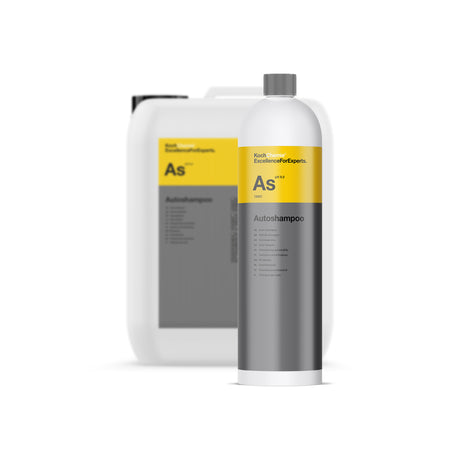
Step one is the wash. Sand and dust sitting on the paint around the sticker act like sandpaper as soon as you go over them with a card, cloth or thumb. A normal hand wash with a shampoo like Koch-Chemie Autoshampoo "As" does the job. Then dry the area, because water between the paint and the adhesive gets in the way when you peel and later dilutes the adhesive remover.
Step two is the heat. Hold the hairdryer 10 to 15 centimetres away and keep it moving over the sticker and its edge. Don't aim at one spot. After one to two minutes, do the hand test: if you can still rest your hand on the paint comfortably, it's warm enough and not too hot. If it's too hot for your hand, it's too hot for the paint.
Then lift a corner with the loyalty card. Square stickers are easier to start than round ones; with round ones, start at the flattest point of the edge. As soon as the corner is free, pull it back flat and keep the hairdryer working just ahead of the peel line. If the sticker tears anyway, give the new edge a quick blast of heat and start again from there.
At an outside temperature of ten degrees like this week, the paint cools down again quickly. So work in small sections and reheat more often. If you need a dry day for the wash, pencil in Monday: Nordhorn is forecast nine hours of sunshine and around 14°C. Tuesday stays dry as well.
An adhesive remover dissolves the residue, and then the paint needs protection
Adhesive residue left after peeling isn't scrubbed off but dissolved chemically: adhesive remover on a microfibre cloth, press it briefly onto the residue, wipe off without pressure, then wash again and seal.
Koch-Chemie Eulex "Eu" 1000 ml / 1 litre is pure n-butyl acetate, a fast-evaporating solvent. It works its way between the adhesive chains and turns that stubborn rim into a soft mass. In practice that means you wipe the adhesive off instead of scraping it, and the surface is dry within a few seconds. Koch-Chemie approves Eulex for solvent-resistant surfaces such as paint, glass, ceramics and metal, and it carries Daimler approval.
Put the Eulex straight onto the folded cloth, not onto the paint. That keeps the solvent where the adhesive is, instead of running over seals or plastic trim. Press the wet cloth onto the residue for a few seconds, then wipe in one direction without any force. Once the cloth picks up colour, fold it over to a clean side, or you'll just spread the dissolved adhesive around again. Thick residue needs two or three passes. Eulex flashes off fast, so work small areas one after another.
SONAX PROFILINE Stain Ex evaporates more slowly. According to the directions, you spray it onto a cloth, lay the cloth on the spot for 30 to 60 seconds and then wipe off, ideally with the paint between 15 and 30°C. When a rim of adhesive is old and hard or sits on a vertical panel, that longer dwell time works more thoroughly than a quick wipe. For fresh, soft residue, Eulex is the quicker route.
Both also shift the odd tar spots behind the front wheel and on the sill, using the same routine. For tar over large areas, a dedicated tar remover is the right tool, as it dwells longer and rinses off. How this fits into a full paint clean is covered in our article on removing flash rust, tar and tree sap from paint.
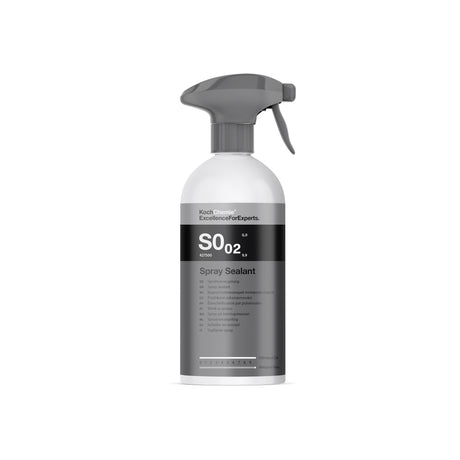
A solvent can't tell adhesive from paint protection. Any wax or sealant on that spot is gone afterwards. That's why you wash the area once more with shampoo and seal it again, for example with Koch-Chemie Spray Sealant "S0.02". Spray it on, spread it with a fresh cloth, done.
Adhesive remover has no business on plastic headlights
Adhesive removers are made for solvent-resistant surfaces: on polycarbonate headlight lenses, acrylic glass, fresh paint and paint without clear coat they can etch the surface within seconds.
Koch-Chemie states explicitly that Eulex is not suitable for polycarbonate, polyacrylic and similar plastics. Almost all modern headlights have polycarbonate lenses. So a sticker on a headlight remains a job for heat, patience and a mild shampoo. SONAX sets the same limit for Stain Ex on acrylic glass and Plexiglas and warns against paints without clear coat, the kind you find on older vehicles. There the product starts to dissolve the colour pigments, and the cloth turns the colour of the car.
Freshly painted parts need time for the paint to cure. If a part has just come back from the body shop, hold off on solvents until the painter gives you the go-ahead. Rubber seals and unpainted plastic trim next to the sticker are best masked off with masking tape so that not a single drop runs onto them.
A second mistake happens in the sun. A black roof in direct sunlight quickly gets above 40°C. The adhesive remover then evaporates before it reaches the adhesive. It barely works, and the residue turns smeary. Work in the shade or in the morning while the panels are cool. In the cold, the opposite happens. Below 10°C, Stain Ex works more slowly according to the directions, and old adhesive turns hard and brittle. In that case, warm the spot briefly with the hairdryer before the cloth goes on.
And sometimes what's left after peeling isn't adhesive at all. Take off a sticker that has been on for years and you'll often see a lighter or darker outline. Under the sticker the paint was shielded from sun and wash brushes, while the paint around it has aged. More adhesive remover won't change that. A machine polish evens out the difference, as described in our article on car abrasive polishes. Small outlines also fade after a few washes.

Five products cover stickers, adhesive residue and tar spots
For stickers, adhesive residue and the odd tar spot you need a hairdryer, a loyalty card and five products: an adhesive remover, a slower alternative, microfibre cloths, shampoo and a spray sealant.
Koch-Chemie Eulex "Eu" is the adhesive remover for almost every job on paint and glass. A litre goes a long way, because each spot only needs a few millilitres on the cloth. If you remove a few stickers a year, one bottle will last you a long time. Its drawback is the smell: Eulex smells strong and flashes off fast. So work outside or with the door open and wear nitrile gloves. Verified buyers on Trusted Shops report that it's powerful stuff and recommend gloves and a mask.
SONAX PROFILINE Stain Ex 1000 ml / 1 litre is the pick for old, hard rims of adhesive, because the cloth laid on top dwells for 30 to 60 seconds. If you spray it directly, SONAX requires a respirator with a type A filter. Using the cloth as a carrier gets round that problem and lets you dose more precisely. Paint in blazing sun and paint without clear coat stay off limits for it too.
For cloths, use the THE COLLECTION "Allround 365" short-pile edgeless microfibre cloth (365 GSM) in 40 x 40 centimetres. The short pile picks up dissolved adhesive well, and the edgeless border has no hard seam to drag across the paint. Keep a dedicated cloth for solvents and wash it separately from your drying towels. After adhesive and tar, it has no place on a freshly polished panel. The pack of 3 covers adhesive, wiping down and sealing.
For the follow-up wash, use Koch-Chemie Autoshampoo "As" 1000 ml / 1 litre. At 1:15, about 65 millilitres go into a 10-litre bucket, so a litre is good for around eight washes. At pH 9 it's slightly alkaline, which means it takes solvent residue with it too. After that comes Koch-Chemie Spray Sealant "S0.02" 500 ml. It builds a water-repellent layer back up on the freshly cleaned spot. If you've just sealed the whole car, this simply brings the treated area back in line. You'll find an overview of other products in the adhesive remover category.

Detailing1-Insight: We get a lot of questions about adhesive removers, and almost every time the same detail is missing: what surface the residue is sitting on. Our answer is a test patch. Mask off five by five centimetres with masking tape next to the sticker, treat that patch and check it dry, at an angle in the light. If the gloss stays the same, carry on. On headlights you can skip the test, because Koch-Chemie explicitly rules out polycarbonate for Eulex.
No time for the whole post? Get it summarized: