

The rinse bucket decides whether your hand wash leaves swirls
It'll keep raining on and off until Sunday, then the forecast says dry from Monday through Wednesday. That's the first calm wash window in days, and plenty of people are setting out two buckets for the first time. One question keeps landing in our inbox, almost word for word: how much shampoo goes in the bucket, and how do I tell when the water's done? Those two points are exactly where the method either works or doesn't.
The two-bucket method only protects your paint if the rinse bucket does its job. That takes enough water, a grit guard on the bottom, the right amount of shampoo in the second bucket and one simple move: scrubbing the mitt against the grit guard after every panel.
Two buckets keep the wash solution apart from the dirt in your mitt
The two-bucket method is a hand wash with separate buckets: one holds the shampoo solution, the other clean water where you rinse the wash mitt after every panel before it goes back into the shampoo.
Sounds like a detail, but it's the whole trick. With a single bucket, the mitt dumps its dirt into the wash solution every time you dip it and picks it straight back up when you pull it out. By the third panel you're no longer washing with shampoo, you're washing with watered-down road grime. The second bucket breaks that loop: the dirt ends up in the rinse water and the shampoo stays clean.
To keep the dirt at the bottom of the rinse bucket, you drop in a Grit Guard, a round plastic grid with vertical fins underneath. Depending on the model it sits 3.5 to 6 cm above the bucket floor. Below it the water settles, sand sinks through the openings and doesn't get stirred up again on the next dip. A standard insert holds about 3.8 litres of water underneath, and that's the space where all the dirt from the whole wash ends up.
If you've ever slowly tipped out a rinse bucket after a wash, you know the sight: the water up top is grey, and under the grid sits a layer of fine sand and dark sludge. Without a second bucket and a grit guard, that layer would have stayed in your mitt and gone straight across the bonnet on the next pass.
One grain of quartz in the mitt scratches the clear coat with every pass
Road dust contains quartz with a Mohs hardness of 7, while automotive clear coat sits at 2 to 4. Every grain that gets trapped between mitt and paint cuts a fine groove into the top layer.
The Mohs scale measures which material can scratch which. A gap between 7 and 4 at most means one thing in real life: the paint loses every contest with the sand. Then there's size. A big share of road grime and brake dust is made up of particles of 5 to 10 microns. You can't see them and you can't feel them in the fibres. Your clear coat feels them anyway.
On a modern car the clear coat itself is 30 to 60 microns thick, and the whole paint system from primer to surface usually comes in at 100 to 160 microns. Every groove you put in while washing takes a little of that away. In low autumn sun or under an inspection light those grooves break up the light, and you get the familiar spider web of swirls. Next time you polish, you take off more material again to get rid of them.
Autumn adds something summer doesn't have. Wet leaves, spray off the road and the film of rain and dust now sit mostly on the lower third of the car: sills, door bottoms and bumpers. Keep washing down there with the same mitt you used on the roof and you load its fibres with the coarsest grit on the whole car. That's why the two-bucket method isn't a ritual for perfectionists. It's the easiest brake on damage that stacks up wash after wash.

A 20-litre bucket needs 15 litres of water and 100 ml of shampoo
For the two-bucket method you need two buckets of about 20 litres each, filled to roughly three quarters, a grit guard in each one and a shampoo you dose by the amount of water.
The size isn't a luxury. A 20-litre bucket dilutes the dirt you rinse into it far more than a 10-litre household bucket, and it's deep enough for sand to sink well below the zone where you're moving the mitt. In practice you fill it with 15 to 16 litres. That leaves enough room at the top so nothing slops over when the soaked mitt goes in. The rinse bucket can be a bit lower, half to three quarters full is fine, as long as the grit guard sits well under water.
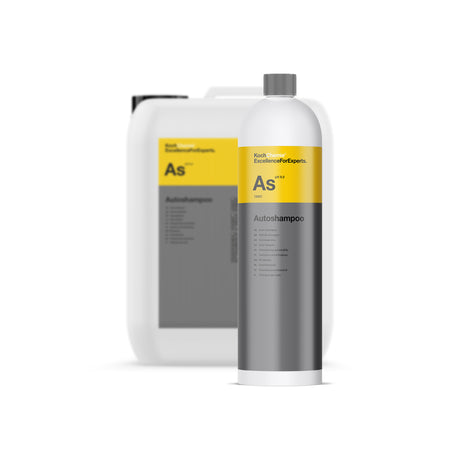
Dose the shampoo by the water, not by the bottle cap. For a normal hand wash, Koch-Chemie Autoshampoo "As" goes in at about 65 ml per 10 litres, so for 15 litres that's around 100 ml. One litre gets you roughly eight washes on a mid-size car. If your paint is ceramic coated, grab a maintenance shampoo with pH 6 instead: Koch-Chemie Ceramic Effect Shampoo "Ces" is mixed at 50 ml per 10 litres.
The Koch-Chemie bucket has no scale, so here's a simple trick we give customers who ask exactly this: once, pour in 10 litres with a measuring jug or two full 5-litre jerry cans and mark the level on the inside with a waterproof pen. After that you never measure again. Lukewarm water is fine. At 20 to 30 °C the shampoo dissolves better than in cold tap water and softens the grime film on the paint faster. It doesn't need to be any warmer.
Before anything touches the paint, you pre-wash. A snow foam or a pre-cleaner loosens the heavy dirt without contact, then you rinse everything off thoroughly. The more sand runs off at this stage, the less ends up in the rinse bucket later. Wheels get their own third bucket and their own brushes, because hot brake dust has no business in your paint mitt.
After every panel the mitt goes to the grit guard first
The key move of the method is scrubbing out the mitt: after every panel you dip it into the rinse bucket, rub it flat-handed over the grit guard a few times, wring it out and only then load up with fresh shampoo.
A lot of people just dunk the mitt in the rinse bucket and pull it straight back out. That's not enough. The particles sit deep between the fibres, and only the friction against the grid opens up the pile enough for them to drop out. Three or four firm strokes across the grit guard, one wring, done. The dirt then sinks under the grid while you're already back in the shampoo bucket.
Work from top to bottom, from the cleanest area to the dirtiest. Split the car into three zones in your head: roof and glass down to the window line, then down to roughly the middle of the doors, and finally everything below that, including sills and bumpers. Use a second mitt for that bottom zone. One pass covers exactly one panel, half a roof or one door, never the whole side in one go.
The Meguiars Hybrid Wash Mitt holds a lot of shampoo in its long chenille pile and pulls particles deep into the fibres, away from the surface. Glide it in straight lines, along the direction of travel, with no pressure. Its own weight and the lubrication from the shampoo are enough. Circular motions are a bad idea: if a grain does get caught, it draws a circle you can see from every angle, while a straight line often disappears in the light.
How to tell the rinse water is done: once it's heavily clouded, grey to black, or you can see grains of sand floating above the grid, the bucket has hit its limit. Tip it out, give the grit guard a quick rinse and refill. On a properly dirty autumn car that's often halfway through the wash. It takes two minutes and is simply part of the routine, not a sign you're doing anything wrong.

Five small mistakes make the second bucket useless
The two-bucket method rarely fails because of the kit. It's usually the little things in the routine: a grit guard that doesn't sit flat, a mitt on the ground or rinse water that never gets changed.
Mistake one is a grit guard that doesn't fit. A Grit Guard needs a bucket with an inside diameter of 26 to 32 cm so it lies flat on the bottom and doesn't slide around. One customer wrote to us that his insert didn't reach the bottom of his new bucket. That's exactly when water flows underneath the grid and stirs the sand back up. Same story if it wobbles or sits upside down. The fins go down, the flat side of the grid faces up.
Mistake two is the mitt that hits the ground. It happens to everyone at some point, and there's only one right answer: that mitt is out for today's wash. On paving or tarmac it picks up grit and sand that no amount of rinsing will reliably get out of the pile. That's why we always keep a spare mitt within reach.
Mistake three is too little shampoo. Skimp on it and you take away the lubrication, so the mitt drags more than it glides. Number four is pressure. Dirt that only comes off with force belongs in the pre-wash, not under the mitt. Number five is washing in direct sun. That's less of an issue in October, but on a dark bonnet in the midday sun the solution still dries on in seconds, even in autumn, and leaves water spots behind.
To be honest, the method has its limits. Towards the end of a long wash the rinse bucket gets dirty too, so we'd rather change the water once too often. Some pros now work with lots of fresh mitts from a single shampoo bucket and set each used one aside. That's even safer, but it takes five to ten mitts per wash. As a starting point, the two-bucket method is the best trade-off between effort and protection. How to dry the car afterwards without adding new scratches is covered in our post Drying Your Car Without Scratches.
Four pieces of kit are all you need for your first two-bucket wash
For your first two-bucket wash you need two big buckets with grit guards, a long-pile wash mitt and a shampoo you dose by the litre. That's it.
The easiest way in is the Koch-Chemie Detailing Bucket Set (wash bucket, lid and grit guard). The 20-litre bucket has a reinforced rim, the grit guard is included and the click-on lid keeps dust out between washes. There's no scale, so the 10-litre mark is worth doing. For the second bucket, take the identical Koch-Chemie Detailing Bucket Wash Bucket 20L and drop in the Meguiars PROFESSIONAL Grit Guard, which fits buckets with a diameter of 26 to 32 cm. That way both buckets have a grid, and it doesn't matter which one you're rinsing in.
For the mitt, the Meguiars Hybrid Wash Mitt is a good place to start because it carries plenty of solution and can go in the washing machine at 30 to 40 °C, no fabric softener. Its limit: chenille is tough, but not quite as soft as lambswool. If you run very soft paint and don't mind the extra care, you'll find wool as an alternative in our washing gloves category.
For shampoo, Autoshampoo "As" covers most cars. One litre does about eight washes, and at pH 9 it cuts through road film without stripping wax or sealant. On a fresh ceramic coating, stick to the weakest dilution or go straight for the Ces.
A word on where to wash: in Germany, washing your car on public roads or on unsealed ground isn't allowed, and on your own driveway it's down to the local council. That's why most enthusiasts there wash at a self-service wash bay, where oil separators catch the waste water, and bring their own buckets. A lid on each bucket makes the trip in the boot a lot less stressful.
What's behind the principle and why a single bucket costs you paint, we've explained in The Two-Bucket Method: Why One Bucket Could Cost You Your Paintwork, and you'll find the full wash routine including pre-wash in Washing your car right, without swirls.

Detailing1 insight: When beginners still end up with swirls despite the two-bucket method, the most common reason we see isn't the mitt. It's rinse water that never gets changed after the roof. Our check after every wash: slowly tip the rinse bucket out over a drain and look at the grit guard. If there's more than a centimetre of sand underneath, the water was already done halfway through the wash. Next time, change it once the sides are finished, not when you're done.
No time for the whole post? Get it summarized: