

Cleaning your car's air conditioning when the vents smell musty
There's a moment nearly everyone knows and almost nobody reads correctly: you start up in the morning, turn the blower on, and for two or three seconds it smells like a damp cellar. Then it's gone. Most people blame the cabin, hang an air freshener in there and wonder why it's back the next morning. But the smell isn't coming from the cabin at all.
Musty air out of the vents almost always starts at the air conditioning evaporator, not on the surfaces inside the car. Separate the two and you clean in the right place with far less product.
The smell comes from the air path not from the cabin
A musty smell from the vents is a moisture problem: the air conditioning evaporator chills the air below the dew point, condensation settles on its fins, and micro-organisms move into that permanently damp metal. What they give off is exactly the smell you pick up.
That also explains the timing. While the air conditioning runs, the evaporator is wet and cold, the air passes over it and takes little with it. Switched off, it dries down slowly, and that's the phase where the film lets go of its smell. So it usually hits you at start-up, not while you drive.
Here in Nordhorn we had 96 per cent humidity at 16 degrees this morning. That exact combination — a season of hard air conditioning use, then cool damp mornings — pushes this topic up every September. In Germany, search demand for cleaning a car's air conditioning peaks in September, and over the last eight weeks it has already run well above the twelve-month average.
The second spot in the air path is the cabin filter, often called the pollen filter. It sits ahead of the evaporator and catches what comes in from outside. Once it's saturated it becomes a smell source in its own right. Both spots sit behind the dashboard — and no cleaner you spray onto a surface reaches either of them.
One number puts it in perspective: on a mid blower setting a car's ventilation pushes several hundred cubic metres of air an hour through that duct. That's many times the cabin volume, every hour. Which is why a film of a few grams in the air path out-smells a completely cleaned interior — the area is small, the throughput is not.
Why fragrance drags the problem along instead of solving it
An air freshener lays a second smell over the first. The source stays damp, stays active and keeps producing. After a few days you get both at once, and that is regularly worse than the original must on its own.
More relevant in practice is what sits underneath: what you smell, you also breathe. The air passes the film on the evaporator first and your lungs second. If you spend time in the car, commute, drive kids around or work out of it, this is a hygiene question, not a comfort question.
The third reason is economic. As long as the damp source stands, you burn through fragrance forever without ever finishing. One treatment in the right place lasts until the next air conditioning season — provided you do it properly once instead of half-doing it twelve times.
That's exactly why this starts with a diagnosis, not a spray bottle. It costs you two minutes and decides whether you need to touch the air conditioning at all, or whether your smell comes from somewhere else entirely.
On top of that there's a detection problem. Because the smell only shows in the first few seconds and then disappears, you get used to it and file it away. Passengers pick it up immediately, because their nose hasn't adapted. If someone tells you your car smells odd and you notice nothing yourself, that's not a contradiction — that's the normal case.

Steps one and two are diagnosis and filter
If you want to clean your car's air conditioning, you start with two minutes of diagnosis instead of a spray bottle. The test that settles it: engine on, air conditioning button off, recirculation off, blower on the second-highest setting, windows shut. If it smells musty now, the problem sits in the air path. If it only smells once you switch the air conditioning in, the evaporator is the source. If it doesn't smell at all, it's the surfaces.
The reason that split works is mechanical. With the compressor off, dry air travels the same route. Whatever still smells is sitting as a film in the duct or in the filter. With the compressor on, moisture joins in, and an evaporator that's already colonised speaks up straight away.
Step two is the cabin filter. On most cars you get at it behind the glovebox or under the windscreen, and it's the one part of the air path you can replace outright rather than clean. A filter that's gone grey-brown and smells of cellar undoes every other measure. Demand for that change, by the way, runs steady all year with a spring peak — it's a service interval, not a seasonal job.
Only once the filter is new does the rest pay off. A freshly treated evaporator behind a saturated filter smells the same again after a fortnight, and you write the product off as useless when the order was simply wrong.
How to spot a filter that's due without pulling it out: the glass mists up faster in the morning than it used to, blower setting three feels like setting two did, and the smell gets stronger rather than weaker as you turn it up. All three point to a filter that no longer lets air through but dams it — and a dammed filter stays damp longer.
Steps three and four are vents and cabin air
The vents are the visible part of the air path and the only part you get your hands on directly. A film of dust, skin flakes and pet hair builds up in the slats that a cloth never gets to, because it bridges the edge instead of going down between them.
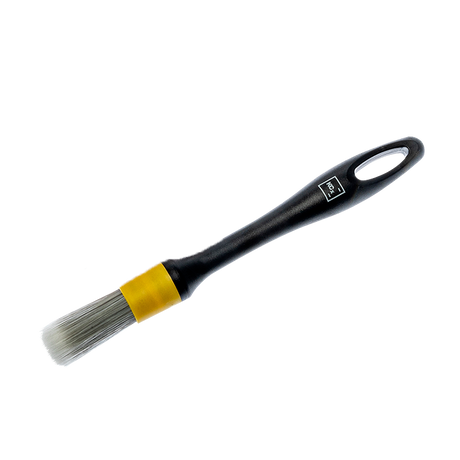
That calls for a medium-stiff brush. The Koch-Chemie Interior Brush „Gelb" has exactly the bristle grade that goes between the slats without marking the plastic edge. A customer asked us precisely that — whether the brush suits cabin vents and whether it's safe on door cards. Yes to both, for the same reason: it works in structures a flat fibre can't reach. More sizes sit in brushes and detailing brushes.
Direction matters. You work from the inside out of the slot, not into it — otherwise you push the dust into the duct you're trying to empty. And the cleaner doesn't go into the vent, it goes onto the brush or the cloth. The THE FINISHER „InsideUp" interior cleaner in 500 ml is built for that, because it's formulated as a gentle cleaner for hard plastics and doesn't attack the slats.
Not every outlet is equally reachable. The round vents in the centre and at the sides work out nicely with the brush, the flat defroster slots under the windscreen barely do — the brush sits too steep there. For those, a soft nozzle on the vacuum is the better answer: pull the dust out rather than brush it out, or you just redistribute it across the dashboard.

Step four is the cabin air itself. This is where the Meguiar's ULTIMATE Whole Car Air Re-Fresher does the work: 57 grams of aerosol that spreads through the running recirculation into ducts, cavities and trim layers and binds odour molecules chemically instead of covering them. Engine on, recirculation on, can upright in the footwell, valve locked down, get out, doors shut, wait around 15 minutes, then air it out for at least 10.
These four mistakes make the must worse
The most common mistake is spraying cleaner straight into the vent. The liquid runs into the duct, soaks in where it never dries, and hands the film exactly what it lives on. After a few days it smells worse than before — with the extra downside that you can no longer pin the cause down cleanly.
Mistake two is the order. Aerosol before the cleaning is wasted product: it's a neutraliser, not a cleaner, and it works against every source still sitting in the car. Vacuum first, wipe the surfaces, change the filter — then neutralise. The manufacturer says so itself, and it's the point where most applications fall over.
Mistake three is switching the air conditioning off too early in daily driving. Turn it off five minutes before you arrive and leave the blower running, and you dry the evaporator down before you park. Cool right up to the parking spot and you shut down a wet component that then has all night. That's the one habit on this list that changes something permanently.
Mistake four is expectation. A customer asked us how long the odour effect lasts — the honest answer hangs on the source. Gone means gone. Still in the car, and the treatment is a top-up with an expiry date, not a result.
A fifth point belongs here for completeness, even if it isn't a mistake in the strict sense: permanent recirculation. Leave recirculation on day to day and you keep the moisture from breath and wet clothes in the loop instead of sending it out. For ten minutes in a tunnel or behind a diesel, recirculation is right — as a default setting it works against you.
Your starter setup for the air path
Four items cover the whole routine. The brush for the slats, a gentle cleaner for the hard plastics around them, a neutraliser for fabric and source, and the aerosol to finish off the cabin air. Nothing more is needed, and three of the four keep working all year.
For the source in the fabric, the COLOURLOCK „Fresh Up" odour neutraliser is the right call. The 250 ml bottle is a screw-top without a spray head, so you put it on the cloth or decant it into a spray bottle — that's not a shortcoming, it's the format. Users rate it just under five stars on average, confirmed by verified reviews at Trusted Shops.
With the aerosol it's worth looking at the quantity: 57 grams is built for exactly one full treatment, not for topping up. For really stubborn cases — years of smoke, permanent pet smell — a second treatment after 24 hours is intended. Knowing that, you grab two straight away instead of being disappointed after the first go. Alternatives sit under interior cleaners.
Once a year to clean your car's air conditioning covers the full routine, and the moment is now: after the air conditioning season, before the heating period locks the damp air inside the car. How the same air path is handled in pollen season is in our piece on air conditioning and ventilation in pollen season. And if the test tells you the smell really does come from the surfaces, which household remedies work inside the car takes it from there.
A word on how far each one goes, because the sizes differ wildly: the brush and the cleaner stay with you for years, or over many interior sessions; the neutraliser in 250 ml covers several treatments of seats and mats; and only the aerosol is deliberately a one-shot for exactly one pass. That asymmetry is intended, and it's the one point people miss when they plan the order.

Detailing1 insight: The honest limit first: for foaming the evaporator directly we deliberately don't stock a product. You need to know the air flaps for that, and foam put in blind leaves more moisture in the duct than it takes out. On a test car with classic cellar smell there was nothing left after a new cabin filter and one aerosol treatment. Start with the two spots you can reach yourself — if the smell stays, that's a workshop appointment.
No time for the whole post? Get it summarized: