

Your pre-cleaner decides which foam sprayer survives
The foam sprayer is on the bench, the concentrate sits next to it, and the question before you pour is always the same: do these two actually go together? Those messages land in our chat all the time, often three in a row from the same customer. Can the alkaline pre-cleaner go in, can the pH-neutral one go in, and what happens if you get it wrong.
A foam sprayer is not a neutral bucket with a handle. Its seals are built for one pH window, and that window is printed on the machine, not on the bottle. Match the two and you get a proper pre-wash without a pressure washer, and a tool that lasts for years.
A foam sprayer brings its own pressure
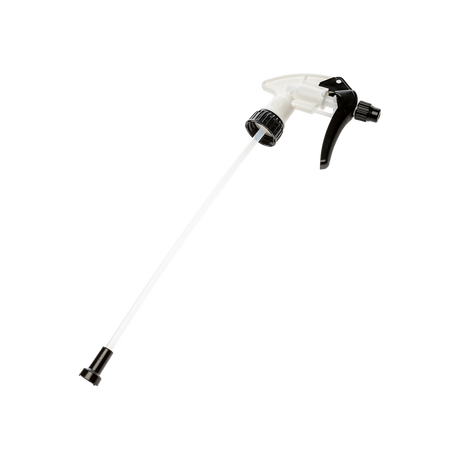
A foam sprayer is a pressure sprayer that whips air and cleaning solution together in a foam nozzle and lays down a clinging blanket of foam. It needs no pressure washer and no tap.
That makes it a completely different animal from the foam lance. The lance has no pressure of its own, it feeds off the pressure washer and pulls your pre-diluted concentrate into the water stream through the venturi effect. The foam sprayer carries its pressure in the tank, either you pump it up yourself or a compressor does it for you. If you work in an underground car park, under a carport or outside a rented flat with no hose connection, this is the only route to a real pre-wash.
And it pays off on the physics alone. Automotive clear coat sits somewhere between 2 and 4 on the Mohs scale, the quartz in road dust sits at 7, and the odd mineral particle gets to 8. Translated: the dirt on your car is harder than the layer carrying it. Drag a wash mitt over that and you are using sandpaper.
How expensive that gets was measured by the Technical University of Munich together with Mercedes-Benz, and later replicated by the University of Texas at Arlington. After 25 hand washes, roughly a year of washing, the deepest scratches reached up to ten percent into the paint film. On a clear coat of 30 to 50 microns that is three to five microns you will be missing when you come to polish. The groundwork is covered in detail in our guide to touchless pre-washing with snow foam.
The work inside the foam is done by surfactants. These are molecules with a water-loving head and a fat-loving tail that wedge themselves between the water and the dirt film and drop the surface tension of water from around 72 to under 30 millinewtons per metre. Instead of beading up and running off, the solution creeps into every pore of the grime, wraps around grit and pollen and holds them in suspension. In practice that means whatever runs off takes the abrasive with it, before your mitt ever finds it.
Hand pump, compressor valve and battery part ways on pressure
All three builds make the same foam, but they hold the pressure for very different lengths of time. That is what decides whether the foam sits on the panel or slides off after two minutes.
On the classic pump sprayer you build the pressure by hand. In practice that is around 45 to 50 strokes before the relief valve blows off. After that the pressure drops with every trigger pull, the foam visibly thins out and runs quicker. That is not a fault in the machine, it is plain physics: less pressure means less air in the nozzle and a wetter, weaker lamella.
The compressor valve version does not save you the pumping, but it lets you fill the tank from outside. The iK Sprayers "iK Foam" Pro 2+ (Plus) foam sprayer with compressor valve is exactly that middle step: same foaming tech, but a universal valve that gets the pressure into the tank in seconds rather than fifty strokes.
The third build tops the pressure up on its own. The iK Sprayers "iK e Foam" Pro 2 electric battery foam sprayer carries a 7.4 volt battery with 3,200 milliamp hours and a small compressor in the base. It runs at 2 to 3 bar and tops up as soon as the pressure falls. Measured, it holds a steady 2.2 bar or so, with the safety valve opening at about 3.5 bar. One charge carries eight to ten tank fills.
You also set the foam grade yourself, and this is where most people go wrong. Three swappable nozzles take you from wet to dry foam, and the temptation is to run it as dry as possible, because that is what looks like shaving cream in the videos. A dry blanket has almost no water left in it though, and water is what carries the surfactants. It then sits on top, tears away as a slab and drops to the floor before the chemistry has done anything at all. The foam that actually works is the wet, half-transparent film that opens up slowly.

The pH window is on the machine, not on the cleaner
The seals, piston and valves in a foam sprayer are built for one pH range. Put alkaline chemistry into an acid-rated machine and you do not ruin a bottle, you ruin the valve.
solo makes that clearest of all with its type coding. The solo CLEANLine "VARIOfoam" (304 FA / FB) 2 litre foam sprayer comes in two versions with an identical housing: the FA code is for acidic cleaners from pH 1 to 7, the FB code for alkaline ones from pH 7 to 14. Only the seal compounds differ. Both run at 3 bar with a stepless foam-grade dial right at the nozzle, so you can go from gel-wet to standing-dry without unscrewing anything.
At iK the material itself does that job. The iK Sprayers "iK Foam" Pro 2 Alk foam sprayer (alkaline) runs EPDM seals. EPDM is an ethylene propylene diene rubber that keeps its shape against caustics far better than the standard compounds in general-purpose sprayers. You notice it like this: the piston still runs as easily on the twentieth alkaline fill as it did on day one, instead of swelling and binding up.
Ignore the pairing and you will not see the result straight away. The seal swells slowly, the pressure build-up gives out earlier, and one day the valve blows off for no obvious reason. Cases like that reach us as warranty claims fairly regularly, and the trail almost always ends at the concentrate rather than the machine. So it is worth reading the sticker before the first litre goes in.
The same pH thinking applies one step further, on the car itself. Strongly alkaline cleaners attack anodised aluminium and non-ferrous metals, which is why VDA-compliant pre-cleaners carry corrosion inhibitors. Those additives lay a molecular protective film on sensitive metals during the dwell time and keep the hydroxide ions in the caustic away from the surface. The parts at risk are exactly the ones you see on a modern car: shadow-line trim, bare bolts in the engine bay, window surrounds. Without an inhibitor they tarnish, and that does not wash off again.
In a pump sprayer the clock runs faster
The dilution in a foam sprayer is the dilution on the paint. There is no second mixing stage to soak up your mistakes, which is why the time windows are tighter than on a foam cannon.
On a lance your mix gets stretched again through the venturi effect, and the real concentration on the panel often lands somewhere between 1:100 and 1:500. In a pressure sprayer that stage falls away. For Koch-Chemie Active Foam "Af" that means 1:20 to 1:50 in a pressure sprayer against 1:10 to 1:50 in a foam cannon, and the dwell time drops from three to five minutes down to one to three.
The reason sits in the foam physics. Foam is a gas bubble inside a liquid skin, and three processes attack that skin at once: gravity pulls the water down out of the lamellae, gas migrates from small bubbles into large ones and turns the blanket coarse, and neighbouring bubbles merge. A small tank and low pressure speed up all three. The foam then goes off before the surfactants have finished working.
How tight that window is has been written down by the car industry itself. The VDA test knows two application classes: class A allows up to five minutes of dwell time, but heavily diluted at roughly 1:300 on the paint. Class B goes up to 1:30 and caps the dwell time at one minute in return. Both at once, strong and standing for ages, is not on the menu, and that is exactly the combination a pressure sprayer makes easiest to build.
Two more failure points have nothing to do with the machine. Hard tap water ties up the anionic surfactants with calcium and magnesium ions as lime soap before they ever reach the dirt. And warm metal is the fastest route to paint damage: once the carrier water evaporates, the caustic concentrates locally and a safe cleaner turns into an etching solution. So for any pre-cleaner it is cool panels, shade, and no drying on.

Four machines and one concentrate for your setup
Our foam sprayers cover four builds, and each one has a typical use case. What decides it is always the mix of surface area, chemistry and time.
For regular weekend work with alkaline chemistry the iK Sprayers "iK Foam" Pro 2 Alk foam sprayer (alkaline) at 1.25 litres is the clearest call. The EPDM seals are built for exactly that duty cycle, and the volume covers one side of an estate plus the front end. If you run both chemistry directions, you are better off buying twice on purpose than once for everything.
The solo CLEANLine "VARIOfoam" (304 FA / FB) 2 litre foam sprayer is the one to grab when you want to change the foam consistency while you work. For car work you take the FB version for alkaline pre-cleaners. The FA version is meant for acidic wheel cleaners and has no business on paint. Two litres and 3 bar means in practice you get a mid-size car foamed in one go.
The iK Sprayers "iK e Foam" Pro 2 electric battery foam sprayer earns its keep as soon as you do several cars in a row. The feedback on it is split, and that fits the machine: wash twice a year and you barely notice the constant pressure and you carry a battery and compressor for nothing. Work every weekend and you will not go back. The clear tank with the level window and the three-stage charge indicator are the details you only start valuing on the third car.
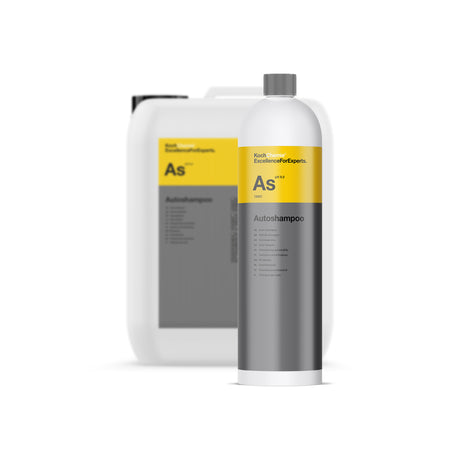
As a concentrate, Koch-Chemie Active Foam "Af" in the 1000 ml / 1 litre bottle fits the bill: pH 9.5, tested to VDA 621-412 for material compatibility on paint, plastic, rubber, carbon and wheels. One litre works out at around ten foam cannon fills or thirty bucket washes, and correspondingly longer in a pressure sprayer. More concentrates at other pH levels sit in our range of pre-cleaners.
Which sprayer fits your washing spot
The choice does not follow your budget, it follows your washing spot and the chemistry you run. Three if-then cases cover almost everything.
If you have no pressure washer and no plans to buy one, the pressure sprayer is your pre-wash tool. There is an honest limit that comes with it though: the foam loosens the dirt, but you still need running water to take it off. A garden hose with a decent nozzle does the job, a bucket and a watering can does not. Skip the rinse and the loosened grime just settles back onto the paint.
If you already work with pressure, the foam sprayer adds to the lance rather than replacing it. It is the quicker route for wheels, arches, sills and bug zones, because there you want to work spot-on and highly concentrated without foaming the whole car. Which machine class suits which surface area is broken down in our guide to pressure washers and flow rates.
And if you do several cars per appointment, pressure consistency is what decides. A hand pump costs you around fifty strokes per car and gives you a foam picture that fades over the tank. The battery keeps it flat, and across four cars back to back that is the difference between an even pre-wash and rework.
One question is best settled before you buy: what is on your paint? Modern silicon dioxide ceramic coatings are chemically stable from pH 2 to pH 13, so an alkaline pre-cleaner leaves them alone. A carnauba wax, on the other hand, breaks down under weekly alkaline pre-washing faster than you want to top it up. If you run wax, take a pH-neutral pre-wash foam and keep the alkaline one for the four or five deep cleans a year. The weather gives you until Wednesday to put your pairing of machine and concentrate together in peace: the first settled working window opens on 2 September.

Detailing1 tip from the shop: What we see day-to-day is people carrying the dwell time from a foam cannon straight over to a pressure sprayer and waiting five minutes. In a pump sprayer the lamellae have drained after three, the foam sits dry on the sill and the only way off is rubbing it. So we work one side at a time: foam one side of the car, wait two minutes, rinse, then do the other. On a light-coloured test car that was exactly the difference between a clean sill and an edge we had to polish out later.
No time for the whole post? Get it summarized: