

Get the leather clean first, then condition it — with COLOURLOCK Pol Star
Ask ten detailers how to clean car leather and you'll get ten holy wars: brush or no brush, microfibre or cotton, cleaner neat or diluted. The one truth that matters gets lost in the noise. Leather in a car wears out faster than any other surface if you don't clean it regularly. We see seats every day that look washed-out after five years, even though the leather underneath is still fine.
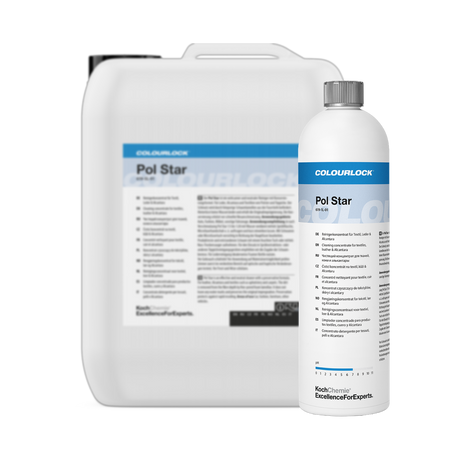
Cleaning car leather always comes before conditioning, never the other way round. Lay conditioner onto dirty leather and you seal the grime in and leave the bolster greasy. The COLOURLOCK Pol Star handles that first step for fabric, leather and Alcantara out of one bottle.
What COLOURLOCK Pol Star actually is
The COLOURLOCK Pol Star is a pH-neutral cleaner concentrate for three material groups inside the cabin: upholstery fabric, Alcantara and pigmented smooth leather. At pH 7 it works without acids, without alkalis and without bleach.
That pH 7 is no side note here — it's the safe zone for dyed leather. Modern car seats carry a thin pigment layer, a kind of painted skin. Aggressive cleaners at a high or low pH bite into that colour coat along with the dirt, the leather goes grey and picks up those telltale pale scuff marks on the entry bolster. A neutral cleaner goes after the film of grime but leaves the pigment alone. That's why pH 7 on leather isn't a compromise — it's a must.
The story behind the label is worth a look. Since Koch-Chemie took over the leather specialist COLOURLOCK in 2025, the proven Pol Star has moved under the new name with its recipe untouched. Same chemistry, mixed in Unna, just with the leather badge on the front. If you knew the ready-to-use Pol Star Po before, you're getting the exact same formulation here as a more economical concentrate instead of a pre-mixed bottle.
One cleaner for seat, carpet and door card replaces three separate bottles on the shelf. That's exactly what makes the Pol Star so easy to live with as a beginner: you don't have to learn first which specialist cleaner belongs on which surface — you've got one neutral tool for the whole cabin. The Pol Star still has its material limits, and we'll get to those further down.
One term worth pinning down is pigmented smooth leather, because it covers by far the most common type of leather in production cars. Makers from Volkswagen to Mercedes-Benz have fitted coated leather for years, because it's lightfast, abrasion-resistant and easy to look after. Practically every seat in an everyday German car falls into this category, and that's exactly what the Pol Star is built for. The pricey exceptions — open-pore aniline leather in some luxury models — are rare and need a different approach.
How to clean car leather with the concentrate
Cleaning car leather with the Pol Star runs in four steps: depending on how dirty it is, dilute 1:5 to 1:20 with water, fill a spray bottle, spray onto a soft brush or a cloth and work it into the surface without pressure. Then you lift the loosened dirt off with a clean microfibre cloth.
The right dilution follows the dirt, not habit. For a light refresh of a well-kept seat, 1:20 is plenty; for a greasy steering-wheel seam or a grey driver's bolster you go to 1:10, or 1:5 on stubborn spots. Never spray the concentrate straight onto the leather — put it on the THE COLLECTION Allround microfibre cloth or a soft brush instead. That way you control the amount and don't drown the seam.
On grained or perforated leather, a soft brush is the difference-maker. It pulls the dirt out of the dips in the grain and out of the perforation holes, where a flat cloth just wipes over the top. Pressure is the key part: you work the brush in small circles with the weight of your hand, not with force. On perforated seats, spray sparingly so no liquid runs through the holes into the padding and leaves a water ring down there.
The last step is what decides the result. The loosened dirt has to come off completely with a clean, slightly damp cloth, or the dirty broth dries back in and the leather looks blotchy. Work section by section, not the whole seat at once, and flip the cloth to a fresh side the moment it goes visibly grey. Then let the leather air-dry, never in blazing sun, before you even think about conditioning.
A short dwell time lifts the result noticeably without any scrubbing. Spray the diluted solution onto the brush, work it in and then give the cleaner a minute or two before you wipe off. In that window the film of grime softens and lets go of the pigment. Don't do this in direct sun or on leather that's been baking hot from driving, or the solution flashes off too fast and pulls edges. Room-warm leather in the shade is the ideal starting point.

What the concentrate delivers day-to-day
One litre of Pol Star makes around eleven litres of ready cleaning solution at 1:10, and up to 21 litres at 1:20. That means a single bottle cleans the seats, carpets and door cards of several cars over months.
That yield is the real lever of the concentrate. If you do interiors regularly, you mix a working solution from one litre that lasts a whole season instead of constantly buying fresh spray bottles. For the home enthusiast it means one litre sits on the shelf for years, because each clean only takes a splash of concentrate in the spray bottle. The maths makes the Pol Star the cheapest way to clean interior leather — with no compromise on the chemistry.
Three material groups from one bottle is more than a convenience when you're working through an interior. Detailing a cabin, you're forever switching between fabric seat, Alcantara headliner and leather console. With one neutral cleaner that spans materials you don't swap product for every surface — you work through in one go. That saves time and it also prevents mix-ups, where a too-harsh specialist product lands on the wrong surface.
The verified customer reviews on Trusted Shops turn up exactly this impression: people describe the Pol Star as thorough and gentle at the same time. That combination is rare in cleaners, because thoroughness is usually bought with aggression. With the Pol Star it comes from the mechanics of the soft brush plus the dwell time, not from an extreme pH.
Where Pol Star ends and protection begins
Pol Star cleans, but it doesn't condition. Clean leather is stripped of its oils and left open — after that it needs feeding back and a UV shield, or the pigment layer dries out and cracks along the fold edges over the years.
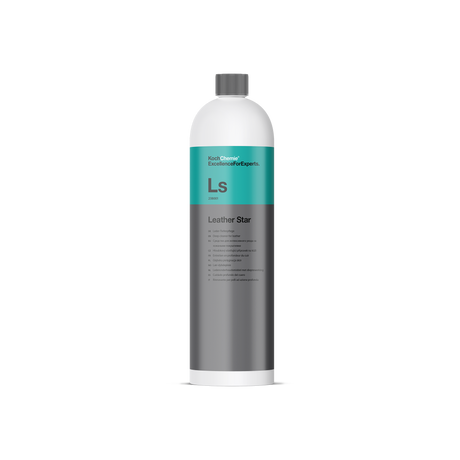
This is the most important limit no cleaner can skip. Cleaning and conditioning are two separate steps with two different products. After the Pol Star comes a leather conditioner like the Koch-Chemie Leather Star Ls, a ready-to-use emulsion with cosmetic esters and active UV blockers. It doesn't seal to a shine — it feeds the oils back into the pigment layer and lays down a satin-matte protective film that guards against light-driven fading. This UV protection is exactly the part customers keep asking us about for their light-coloured synthetic-leather seats.
The second limit is about the material itself. Pol Star is made for pigmented smooth leather, fabric and Alcantara, not for open-pore natural leather. Aniline leather and nubuck or suede soak the cleaner up like a sponge and end up with water rings, because they're missing that protective pigment layer. If you're not sure, do the drop test on a hidden spot: if a drop of water sinks in straight away and darkens, it's open-pore leather and the Pol Star is the wrong cleaner here.
Drying hides a trap too. Dry the freshly cleaned leather in the sun or with a hot-air gun and you pull too much of the remaining moisture out of the pigment layer, speeding up the very cracking the conditioning is meant to prevent. Cleaned leather belongs in the shade and in the air before the conditioner goes on thin. Patience while it dries is the invisible part of leather care.

Concentrate versus ready-to-use and versus all-purpose cleaner
Against the ready-to-use predecessor Pol Star Po, the concentrate gives you the same chemistry in a fraction of the volume; against an alkaline all-purpose cleaner, it protects the leather's delicate pigment layer. Which one you pick comes down to what you're cleaning.
If you only tackle the odd single stain now and then, a ready-made spray bottle is handier because there's nothing to mix. If you clean whole interiors regularly or look after several cars, the concentrate wins hands down: one litre lasts many months, you match the dilution to every kind of dirt and you're not lugging litres of water around. For most regular enthusiasts the concentrate is the more economical and more flexible choice.
The comparison with a harsh all-purpose or interior cleaner is clear-cut on leather. An alkaline heavy-duty cleaner cuts through grease faster, but over time it bites into the pigment and drives the greying on. On fabric seats or in the footwell a cleaner like that makes sense; on dyed leather it's the opposite of care. This is where the Pol Star's neutral pH pays off, because it cleans more slowly but without attacking the substance. You'll find a rundown of suitable products in our leather cleaners category, and for step two under leather care.
If you want to go deeper into the material side — what care coated leather really needs and how to spot greasy over-conditioning — you'll find it in our guide to coated car leather. If it's Alcantara rather than smooth leather, it's worth a look at our piece cleaning Alcantara without ruining the nap, because Alcantara takes the same cleaner but needs a different brushing technique.
Who the Pol Star routine is for
The COLOURLOCK Pol Star suits anyone who wants to clean and protect their car leather regularly and is after a neutral, material-spanning cleaner as the foundation of their care routine — from the weekend enthusiast to the full-time detailer.
For the beginner, the Pol Star is the calm place to start. A cleaner that won't wreck anything as long as you respect the material limits takes the fear out of leather cleaning. You don't need a shelf of specialist products — just a spray bottle, a soft brush, a good microfibre cloth and the patience to work in sections. That covers seats, carpets and trim.
For the regular enthusiast and the pro, the yield is the argument. If you go through the interior every three to six months — more often for high-mileage drivers — you mix a working solution from one litre of concentrate that lasts a long time and adapts to any kind of dirt. That interval isn't a marketing number, it's the rhythm at which everyday grime and skin oils attack the leather before they settle in for good.
There's a seasonal rhythm too. Spring is the obvious time for the deep leather clean, because over winter road-salt dust, damp trouser seats and dry heater air build up inside the cabin. Go through it fully once in March or April and lay on the UV protection afterwards, and you bring the leather into the sunny months protected, when the UV load is at its highest. A second, lighter round in autumn holds the level through the rest of the year.
What matters most is grasping that Pol Star is the first of two steps. Feed clean leather back with the Leather Star Ls afterwards and shield it from UV, and you keep the seats in their satin-matte original state for years. Clean only and skip the conditioning, and you get clean but increasingly dry leather. The routine only works as a pair.

Detailing1 insight: From what we see day-to-day, the most common leather damage isn't a cleaning mistake — it's an order-of-steps mistake. Customers put conditioner on uncleaned leather, the dirt gets locked in under the emulsion and the bolster goes greasy and dark instead of clean. Our rule of thumb in the Showroom in Nordhorn: clean with the Pol Star at 1:10 first, let it air-dry completely, and only then a wafer-thin coat of Leather Star Ls. Skip the first step and all you do is polish the dirt in. And do this every three to six months instead of once a year, and each clean takes far less effort, because nothing gets the chance to settle in.
No time for the whole post? Get it summarized: