

Household remedies don't shift baked-on brake dust
Glass cleaner, oven spray, washing-up liquid, cola — there's a video for every one of them that ends with a gleaming wheel. The test works, too. Cleaning wheels with household remedies does the job reliably — just on a wheel that was already half clean to start with. With the film that has built up over a summer, something else happens: it stays. And not because the household stuff was mixed too weak.
Baked-on brake dust doesn't sit on the clear coat, it sits in it. Hot iron particles melt into the paint surface in a fraction of a second and get locked in mechanically as they cool. From that point on no surfactant will help — only an active ingredient that pulls the iron back out of the paint chemically.
Why brake dust bakes into the clear coat
Every hard stop pushes the contact face between pad and disc well past 400 °C. What comes off there are iron and copper particles between 0.5 and 10 microns, flung outwards red-hot by the spinning disc — straight into your wheel barrel.
The wheel itself sits at 80 to 120 °C in normal use. When a 400 °C particle lands on that much cooler acrylic or polyurethane clear coat, the surface locally goes past its glass transition temperature — the point where a polymer flips from hard to soft.
So the paint softens on a microscopic scale and the particle sinks in. Everything then cools within fractions of a second, the polymer network closes again, and the iron grain is stuck. You spot it like this: the dark speck won't move under your fingernail even though the wheel is freshly washed.
Then part two of the problem kicks off. The trapped iron keeps oxidising with humidity into iron hydroxide, and it gains volume doing so. That expansion creates microscopic stress cracks in the surrounding clear coat.
Once the layer is breached, nobler iron sits directly on less noble aluminium with rainwater as the electrolyte in between. That's a galvanic cell in miniature, and it eats onwards in fine white threads under the paint. Diamond-cut two-tone wheels are especially exposed, because clear coat grips a machined face far less well anyway.
What glass cleaner, washing-up liquid and oven spray actually do
If you want to clean your wheels, you usually reach for the kitchen cupboard first. Every classic household remedy works through surfactants — molecules that lift dirt off a surface and hold it suspended in water. Against three days of dust film that's plenty. Against a particle keyed into the paint they do nothing, because surfactants can't extract anything from a polymer matrix.
Which explains why the household-remedy videos work and still prove nothing. The comments usually say it more plainly than the video does: the wheels weren't really dirty to begin with, and nothing got clean on the inside. Anyone cleaning a lightly dusty wheel can do it with almost anything.
The aggressive end is where it gets serious. Oven cleaner is caustic soda at a pH of around 13 to 14. Aluminium is amphoteric — it reacts not just with acids but with strong alkalis too.
On bare, polished or anodised aluminium the surface dissolves with hydrogen coming off and hazes white. On damaged clear coat the alkali gets under the flaw. Under those videos people describe exactly that sequence: the wheel paint holds out for a while, the painted centre caps give up first.
And cola? Phosphoric acid in cola drinks runs at about 0.05 percent. Overnight that shifts a bit of rust off a bolt. On a vertical wheel face it runs off before anything happens at all.

Acid free does not mean pH neutral
This is the thinking error that costs most wheels. "Acid free" chemically means one thing only: the formulation contains nothing below pH 7. A cleaner at pH 13 built on potassium hydroxide is correctly labelled acid free — and still etches polished aluminium.
The spec that matters is pH neutral, a value between 7.0 and 8.0. That band is the only one that's safe across every wheel finish: clear coated, powder coated, diamond cut, anodised, chromed, matte painted and carbon.
In practice that means: clear-coated and powder-coated wheels are the tough standard and forgive the most. Diamond-cut and anodised wheels take pH neutral only, because alkalis creep under the thin protective layer and acids destroy the oxide layer. On chrome, acidic cleaners leave blind spots you can't polish out.
If you're unsure about your wheel, pH neutral is always the safe call — it's the one category that lets you clean alloy wheels without identifying the finish first. It might cost you a second pass on heavy build-up, but never a surface.
We get exactly these questions — twice recently, almost word for word, whether a cleaner can shift brake dust from wheels at all, and once about matte painted wheels. For matte finishes there's a second rule: cleaners with gloss or wax additives change the matte effect, and hard brushing polishes patches of the microstructure shiny. That doesn't come back.
The if-then rule behind it is simple. If the dirt lifts with shampoo and a soft brush, it's everyday grime and a wash is enough. If dark specks stay behind, iron is sitting in the paint and you need the pH-neutral reactive cleaner. If greasy build-up clings to the rim flange as well, that's organic road film, which the iron reaction does nothing about.
Because the reaction only attacks iron. Intense purple therefore means one thing: there was a lot of brake dust. It doesn't mean the wheel is fully clean. Which cleaner type belongs on which finish is broken down in our guide to picking a wheel cleaner.
If you take one number away, take this one: pH 7 to 8. If it's not on the bottle, it's in the data sheet. If it's nowhere, that's an answer too.
The routine that actually shifts the deposit
The cleaner that dissolves baked-in particles is a pH-neutral reactive cleaner. Its active ingredient is a salt of thioglycolic acid, a chelating agent — a molecule that grabs metal ions like a pair of tongs.
It diffuses into the microstructure of the paint, binds the iron more tightly than the paint holds the particle, and converts it into a water-soluble compound. What that means for you: the grain isn't abraded, it's dissolved and rinsed away — which is why you don't need a brush that scratches.
The violet colour change isn't an effect, it's the reaction itself. That iron-thioglycolate compound absorbs light in a way that reads as deep violet. The Meguiars Ultimate All Wheel Cleaner 24 oz (709 ml) turns that into two readouts: purple for iron from brake dust, brown for organic road film.
It's formulated acid free and pH neutral, and it's set up as a gel. On a vertical wheel that's not a comfort feature, it's the condition for the active ingredient clinging on long enough — thin cleaners run off before the reaction is done.
The routine itself has four steps and the order isn't negotiable. First rinse the wheel cold; cold means it has to feel cool when you put your hand on it. Then apply the cleaner to the wet wheel, barrel and inner spoke faces first, because centrifugal force puts most of the dust there.
The inner spoke faces and the barrel get the first and the longest dose. That's where the dust gets driven, and it's exactly where nobody looks while washing — the reason a wheel looks perfect head-on and streaks again with the next rain.
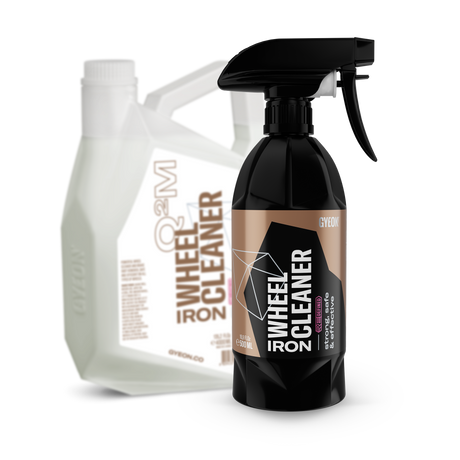
Let it dwell for three to five minutes without anything drying, misting with water if needed. Finally rinse with plenty of water until nothing violet runs out of the spokes any more. If the deposit has built up over months, work with more reserve, say the GYEON Q²M Iron WheelCleaner (REDEFINED) 500 ml.

The mistakes that damage a wheel for good
The most expensive mistake is a warm wheel. On hot metal the water flashes off the cleaner in seconds and the violet complex that has already formed dries onto the paint as a concentrated crust. Those stains barely come off even with clay and polish.
So on days like Thursday and Friday this week, forecast at 32 and 35 °C, the rule is: work early in the morning or in the shade. That isn't about comfort, it's the difference between clean and stained.
The second mistake involves the brakes. Cold water on a cast-iron disc still several hundred degrees hot can warp it, and that shows up later as a pulsing brake pedal. On top of that, spraying intricate spokes generously puts chemistry on the pad.
Surfactants soak into the porous pad structure and noticeably drop the friction on the first few stops. So one controlled dry-braking run after the wash is part of the job.
The third mistake is mechanical. Kitchen sponges, scouring pads and cheap nylon bristles put micro-scratches into soft clear coat straight away. That's not just cosmetic — it enlarges the surface the next lot of brake dust can key into, so the wheel gets dirty faster with every rough clean.
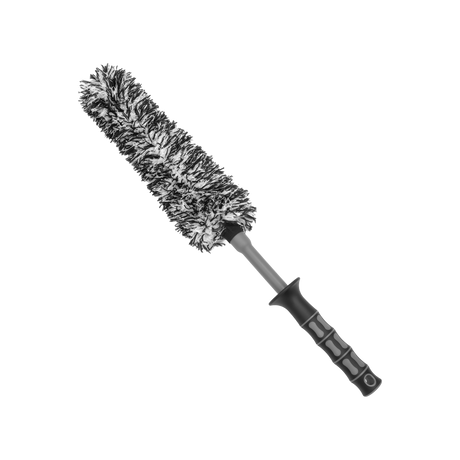
For the faces and the deep barrel use a THE COLLECTION "Flex Brush" Microfiber Wheel Brush, whose microfibre picks the dirt up rather than dragging it around. For spoke roots and wheel bolt holes use the TUGA Chemie Detailing wheel brush for "Alu-Teufel Spezial" (green), whose bristles hold up across the whole pH range and whose ferrule is metal free.
First time round, four wheels realistically take you 45 minutes. By the fifth time it's 20. The first wheel taking longest doesn't mean you're doing it wrong — you're learning how much product a spoke actually needs.
What decides next summer
The honest shortcut is not letting the dust bake in at all. And this is where the most popular household principle finally falls over: wax on the wheel. Carnauba melts at 80 to 85 °C, exactly the band a wheel barrel lives in day to day.
The layer liquefies, picks up hot brake dust like a sticky sponge and washes off with the dirt in the next rain. A ceramic coating behaves the other way round: it forms a hard silicon-oxygen network that copes with temperatures far above anything reaching the wheel.
The particle then cools on the hard layer instead of melting into soft paint. In practice: the dust sits on top and comes off with water at the next wash. Koch-Chemie Ceramic Rims "Cr0.01" 30 ml lasts up to 12 months per the manufacturer, and 30 millilitres covers a full set of wheels.
The window for that is now, while the wheel is freshly stripped and dry. More cleaners and tools for this job sit in the wheel cleaner category. If the same iron deposit is on the paint too, follow the routine in dissolving fallout chemically instead of sanding.
Medium term the picture shifts anyway. From 29 November 2026 Euro 7 applies to newly type-approved cars and caps brake wear itself for the first time: 7 mg/km for combustion and hybrids, 3 mg/km for pure EVs. Pads are moving away from high iron and copper content towards ceramic and mineral blends.
Brake dust on the next generation of cars will be lighter, finer and far less clingy. The violet colour change will get weaker — not because cleaners got worse, but because the iron isn't there. For everything on the road today the physics above still applies unchanged.
This week works out well: it stays dry from Tuesday onwards, and Sunday is the calmest day for it. Check today whether brush, detailing brush and a pH-neutral cleaner are on the shelf, and on Sunday you can clean all four wheels in an hour and a half — with household remedies as a supplement for everyday grime, not a replacement for the iron reaction.

Detailing1 tip from the shop: We see the same pattern on test cars again and again: the front wheels carry far more deposit than the rears, because the front axle does most of the braking. People still spray all four the same and then wonder why hardly anything goes purple at the back while dark specks are still sitting up front after five minutes. Treat the front wheels as their own job — first, with the full dwell time, and a second pass if needed. At the back, shampoo water is often enough on modern cars, especially EVs with enclosed drum brakes on the rear axle. That saves half a bottle per wash and makes the difference where it counts.
No time for the whole post? Get it summarized: