

How to Keep Your Car Shiny Between Washes Without Removing Your Wax Protection
The question comes up every other week in May: What do I spray on between washes when the paint gets dusty, but a full wash isn't due? The answer is quick detailer. Which one is right depends on whether you have wax on your paint – and that's where most beginners make the mistake that erodes their protection within weeks.
A quick detailer is a spray cleaner that removes light dust, fingerprints, and water spots between washes, leaving behind a glossy film. Three Koch-Chemie variants cover typical applications, and choosing the wrong one actively breaks down your paint protection.
What a Quick Detailer Is and When You Need One
A quick detailer is a ready-to-use cleaning and shine spray for exterior paint, glass, and plastic that works without water. You spray a small amount on, spread it with a microfiber cloth, and buff with a second cloth. In ten minutes, the car is presentable again, no bucket, no hose, no hassle of a complete wash.
The application makes sense between two full washes. Pollen film on the hood, light dust after a dry day, a few fingerprints on the tailgate, the salt-burn profile on the windshield after the first summer rain. All of this disappears with a few sprays.
Even those who want to quickly prepare their car for a photo reach for a quick detailer instead of a foam lance. Showroom detailers use it before every handover as a final step after drying, because it removes wipe marks and fingerprints from the final inspection.
What it is not: a substitute for a proper wash. If you try to wipe off bird droppings, baked-on insects, or a layer of Saharan dust, you'll only drag this dirt across the paint and scratch the clear coat. A quick detailer only works cleanly on light dirt. As soon as you feel resistance when wiping, you've gone too far, and the car needs a full wash before you continue.
Why the Wrong Choice Attacks Your Wax Protection
Not all quick detailers are created equal. Koch-Chemie offers three variants, and the crucial difference lies in the pH value. This may sound like a chemical detail, but it becomes a decisive question as soon as you have wax, polymer sealant, or a ceramic coating on your paint.
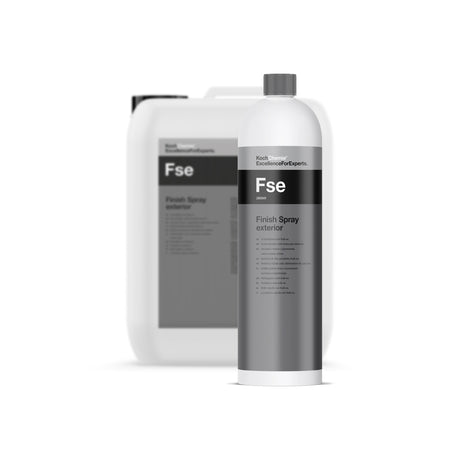
The Koch-Chemie Finish Spray Exterior „Fse" works with pH 2.5, meaning it's acidic, designed for lime spots and mineral residues on glass and paint. The acid neutralizes lime through a direct acid-base reaction: water spots dissolve rather than smear. For visible lime on the windshield, this is exactly the tool.
The other two, Quick & Shine „Qs" and Quick Finish „Qf", are pH-neutral. They clean without attacking the paint protection.
Koch-Chemie itself states for Fse: synthetic waxes, polymer sealants, and ceramic coatings are acid-resistant. However, natural carnauba waxes will have their durability measurably shortened with repeated contact.
Users in car care forums consistently report: those who use Fse weekly on carnauba-waxed paint notice after eight to twelve applications that the wax beading diminishes. The protection doesn't disappear all at once. It erodes slowly.
The difference between Qs and Qf, however, is marginal. Qf is declared silicone oil-free, making it safer on newer paint finishes with fluorine-based clear coat additives. Qs provides a slightly deeper color enhancement. Both preserve waxes and sealants, both leave a slightly hydrophobic film, and both are designed as universal all-round detailers for everyday protected paint.
Steps One and Two: Check the Surface and Prepare Your Towels
Before you spray, touch the paint. Quick detailer only works reliably on cool, dry surfaces. On hot metal after direct midday sun, the spray will dry to streaks within seconds before you can wipe it away. If the hood is still noticeably warm to the touch, roll the car into the shade and wait five minutes.
Today, at 9 °C and mostly cloudy skies, the outside temperature is ideal. The surface cools on its own, and the cloudy sky prevents localized sun heating on the hood. Such May days between washes are the best window for a quick detailer round.
Then the towels. You need two, not one: an application towel and a buffing towel. Both made of soft microfiber, both clean, both dry. If you work with only one towel, you'll constantly redistribute the dissolved dirt on the paint, and that's a direct route to wipe marks and fine scratches.
The Allround 300 Edgeless Microfiber Towel with 300 gsm pile weight is well-suited: short-pile enough for clean absorption, dense enough for streak-free buffing. Those who regularly work in sets have two stacks in their cabinet: one towel color for application, a second color for buffing. This way, the dirty application towel is not accidentally used for the final wipe.
Steps Three and Four: Spray, Work In, Buff Off
For each body panel, two to three sprays directly onto the surface, which means about one door, a quarter of the tailgate, or half of the hood. If you're using a spray head, hold it thirty to fifty centimeters away. From this distance, the spray will atomize evenly instead of hitting in a single spot. Never spray the entire car at once. Finish one area completely, then move to the next.
The spray head set with Canyon CHS-3AN produces a fine mist and dispenses much more precisely than the angled original nozzle. Once you've replaced the spray head, you won't go back. Three sprays cover an entire door on a mid-size sedan. On an SUV or station wagon with a larger area per section, it's four to five.
Then, gently glide the first towel flat over the surface, no circular motions. Straight passes, in the direction of the paint, using the entire towel surface instead of just your fingertips. Along this path, the towel will bind the dissolved dirt. For stubborn lime spots or mineral residues, let the Fse dwell for thirty to sixty seconds before wiping. For normal gloss refreshing with Qs or Qf, direct application without waiting is sufficient.
Buff immediately with the second towel before the product dries. The surface should emerge dry and streak-free from the second towel. If you leave a damp film, you've applied too much product or used the second towel too late. Twenty to thirty milliliters are sufficient for a complete mid-size car, which is significantly less than most beginners assume. A 500 ml bottle, at this consumption rate, will last for about twenty applications.
Common Mistakes That Attack Your Paint Protection
The mistake with the biggest consequences: using the wrong quick detailer on protected paint. If you maintain paint with carnauba wax or a hybrid sealant, opt for the pH-neutral Qs or Qf. If you regularly use Fse on a carnauba-waxed surface, you'll notice after weeks that the water beading isn't as strong as it was at the beginning. The acid has gradually stripped the wax of its bond to the clear coat surface.
The second mistake: spraying too much. In relevant detailing forums, reports regularly appear where beginners have used an entire 500 ml bottle in one wash. The result is not more shine, but streaking, sticky residues, and ultimately a full wash to rinse off the excess detailer. Twenty to thirty milliliters are enough per car. If you spray more, you have a towel problem, not a product problem.
The third mistake: circular wiping motions. They seem intuitively thorough but drag the finest dirt particles in a circular path over the clear coat. The result is the typical swirls that become visible as a star-shaped light play in sunlight. Straight passes in the direction of the paint remove the dirt instead of distributing it.
The fourth mistake is the classic lime spot: spraying Fse onto a hot surface, where it dries before it can dissolve the lime. Three water spots then become five, because the acidic solution itself leaves drying marks.
The fifth mistake is often overlooked in May: applying quick detailer to a layer of dry pollen. The towel distributes the pollen instead of picking it up because there isn't enough solution for the amount of dirt. For a visible pollen film, a snow foam pre-wash is needed beforehand, not a quick detailer.
The sixth mistake concerns the towel itself. A microfiber towel that has been washed with an aggressive cleaner or was in the machine with fabric softener loses its absorbency. The towel looks clean but absorbs hardly any solution. Instead, it pushes the product in front of it. Microfiber towels should be washed separately, without fabric softener, at 40 °C, with a mild washing additive. If you wash the towels with your normal laundry, you can throw them away after three cycles.
Your Starter Setup for the First Twenty Applications
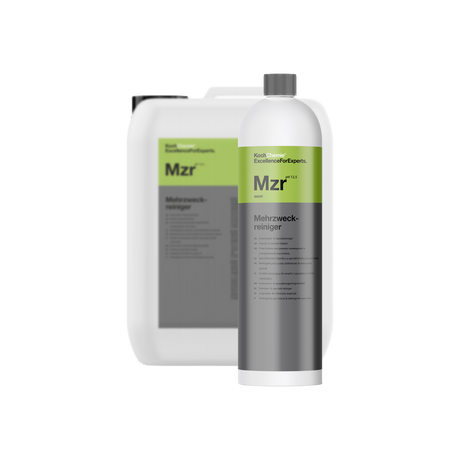
A small selection is sufficient for getting started. A 1-liter Quick & Shine as an all-rounder for everyday paint protection is the first choice when the paint looks dusty. A 1-liter bottle, with precise dosing, is enough for about fifty applications. In addition, the Fse as a special tool for lime spots on glass and paint, which is used once a month instead of every week.
When it comes to microfiber towels, it's worth stacking four or six towels instead of two. Those who work regularly always have a clean set ready, and no dirty one has to wait in the bucket until the next machine wash. The Allround 300 or the longer-pile Allround 365 both work. The heavier 365 glides a little softer over the paint and is more forgiving when choosing the pressure.
If you use a decent spray head, you can retrofit the original bottle with the Canyon CHS-3AN. It atomizes more finely, dispenses more precisely, and distributes the product evenly over the surface. The investment is worthwhile after three or four applications because less product covers more area. If you decant concentrates from the range into a separate spray bottle, you should definitely invest in an HDPE bottle with a good spray head.
A small routine helps: leave two towels and the spray bottle in the car trunk, wrapped in a larger towel. This way, they are protected, dust-free, and immediately available when a fingerprint on the tailgate or a pollen haze on the hood needs to be removed quickly after a drive. Once you've established the quick detailer as a reflex in your daily routine, you'll wash your car less often and still maintain more shine.
Those who work in a carport without a water connection or need quick care on the go can opt for the Wash & Finish „Wf" Waterless-Wash Detailer. It has additional cleaning components and works even with light to medium dirt, without water touching the car. The entire Quick-Detailer section in the shop shows additional variants for special applications.
The sequence throughout the year hardly changes: almost daily in spring and autumn, because pollen and leaves quickly form new films. Once a week in summer, rarely in winter, because detailer residues are difficult to remove in frost.
If you're asking yourself today, on a mostly cloudy 9°C day in May, whether a quick detailer is due: the weather is perfect. Cool surface, no direct sunlight, no Sahara dust warning. If the car is only lightly dusty and you last washed it two weeks ago, this is exactly the window between washes for which the quick detailer was built.
Detailing1-Insight: We see the same mistake every week in our consultations: someone buys Fse because the quick detailer with Kalk-EX sounds convincing, and then routinely sprays it on a carnauba-waxed paint. Eight weeks later, the beading is gone, and the customer asks what they did wrong. Hardly anyone tells you that beforehand. Rule of thumb from our practice: If you spray regularly between washes, use Qs or Qf, pH-neutral and paint-protection-friendly. You bring out Fse when you're fighting visible lime on the windshield or mineral residues on the paint, and then specifically on that spot, not across the entire car.
No time for the whole post? Get it summarized: