

Car Leather Care in Spring: What the Season Has Done to the Seats
Six months of heated air in the interior. First weeks with the convertible top open. A leather interior goes through two of the toughest stress phases of the year between October and May — dryness from the ventilation shaft and sudden UV exposure on the seat bolster. If you don't start your car leather care routine in May, you'll lose suppleness for the next twelve months.
Car leather care is not a polish, but a two-step system consisting of pH-neutral cleaning and a re-greasing emulsion with active UV blockers. Smooth leather, perforated leather, and velour receive the same care; Alcantara and open-pore suede do not.
What Car Leather Care Actually Does
Car leather care is a low-viscosity emulsion that transports cosmetic esters and UV blockers through the PU coating layer of the leather surface to the collagen fibers, restoring suppleness. It does not seal or shine; it keeps the fiber structure elastic.
Pigmented smooth leather in cars is coated ex works with a thin polyurethane layer. This layer is microporous: it protects the collagen fibers underneath from mechanical abrasion and chemical ingress, but allows active ingredients to pass in both directions. Heated air extracts moisture from the fiber composite, and UV radiation through glass roofs and convertible tops breaks down the polymer chains of the PU layer. Both effects are cumulative and become visible in spring — as a dull, slightly muted seat bolster that feels rougher when you sit on it than it did in autumn.
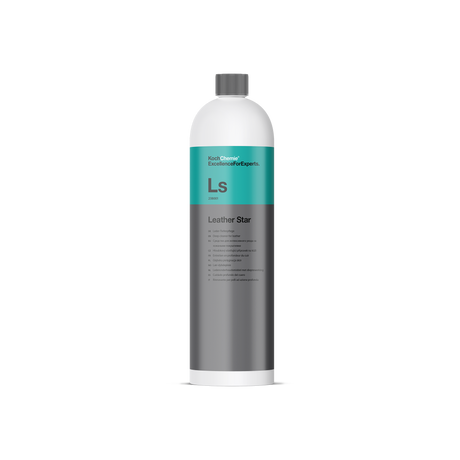
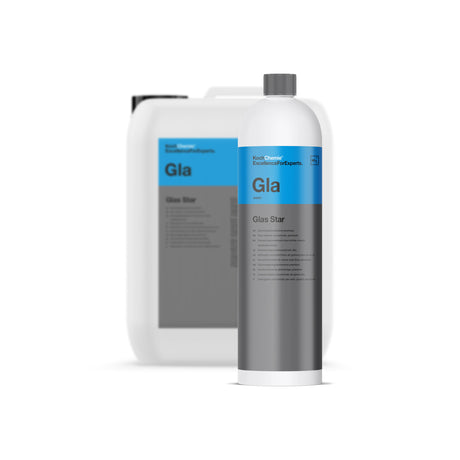
Good leather care offers three mechanisms of action: re-greasing of the collagen fibers for suppleness, an anti-adhesion effect on the PU coating surface against jean transfer and friction, and dedicated UV absorbers against photochemical degradation. The Koch-Chemie Leather Star "Ls" covers all three and contains 10 to 25 mass percent of aliphatic C10–C13 hydrocarbons as a volatile carrier substance that evaporates without residue. What remains is a wafer-thin layer in the fiber composite — no wax film, no sticky shine.
The spring season is therefore the natural time for care: between March and May, convertibles emerge from hibernation, at the same time the heating phase in the interior ends and UV exposure begins to rise without having reached the summer peak. Those who thoroughly care for their leather during this phase can postpone the next care appointment until early autumn — the second classic detailing slot before the next heating season. Both appointments are reflected in DACH search behavior annually at Detailing1 and are the weeks when leather care typically has the best availability.
Smooth leather, perforated, velour. Not Alcantara
Car leather care sharply distinguishes between pigmented material with PU coating and open-pore suede. Smooth leather, perforated leather, and velour leather receive the emulsion. Alcantara, long-pile suede, and cracked patent leather do not.
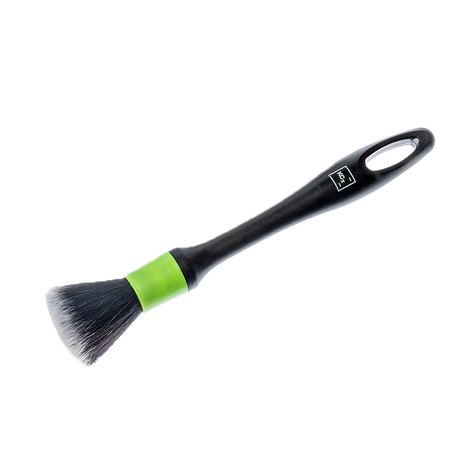
Most car leather interiors, from an Audi A4 with standard equipment to a BMW M3 with full leather sports seats, are pigmented smooth leather. The PU layer is closed and color-pigmented; the care product penetrates through the micropores and does not remain as a film. For perforated leather with ventilation function, the application is the same — it is crucial to rework the rows of holes with a soft brush, otherwise the emulsion will dry into a white ring in the perforations. The application images in the workshop workflow show exactly this second pass with a detail brush over the seat perforations.
Velour leather with a short pile — typical for seat bolsters in BMW Individual or Audi exclusive — is also treated with Leather Star, because the low-viscosity emulsion penetrates the fiber structure instead of merely sitting on top. Alcantara, however, is a microfiber fleece made of polyester and polyurethane without a coating layer; a greasy care product would gum up the fleece and create a greasy sheen that cannot be brushed out. Only pH-neutral cleaner belongs on Alcantara, nothing else. Even long-pile suede and damaged patent leather with visible cracks require leather center or restoration workflows; standard care will not conceal anything there and, in the worst case, will accelerate further damage.

What really matters when choosing
For car leather care, three strict selection criteria apply: a dedicated UV block, a matte OEM look without a greasy shine, and a consistency that penetrates the micropores of the PU layer instead of merely sitting on top. The price per application is secondary.
The UV block separates active leather care from cosmetic leather care. Classic wax or Carnauba-based care products form a closed film on the surface and reduce breathability — this feels smooth for a short time but accelerates long-term moisture loss of the collagen fibers. Care products with dedicated UV absorbers, such as HALS components, actively intervene in the photochemical reaction and push back the light-induced fading point for light aniline leather by one season. For convertibles, UV protection is the heavyweight factor; for pure city cars with tinted glass roofs, it is less critical but still relevant.
The second point is appearance: car leather comes from the factory with a semi-matte OEM look. As soon as the care product creates a visible shine, it is over-applied or has the wrong wax base. Repeatedly read in reviews for Leather Star: "cares for the leather without leaving a greasy shine". This note is more important than any list of ingredients — a care product should not make the leather shine; it should keep it matte.
The third point is consistency. Low-viscosity emulsions penetrate through the PU micropores and leave no film on the surface. Waxy pastes and thick lotions remain on the layer, collect dust, and create a shine later. The rule of thumb in the workshop test: one drop of care on the thumbnail — if the liquid spreads within a few seconds, the viscosity is correct. If it remains as a drop, it is too thick for PU-coated smooth leather.
First clean, then care, then buff
The standard workflow for spring leather care begins with the cleaner, not the care product. A pH-neutral cleaner concentrate dissolves skin oils, sweat, and jean abrasion from the leather pores — and only clean, completely dry leather should receive the care product.
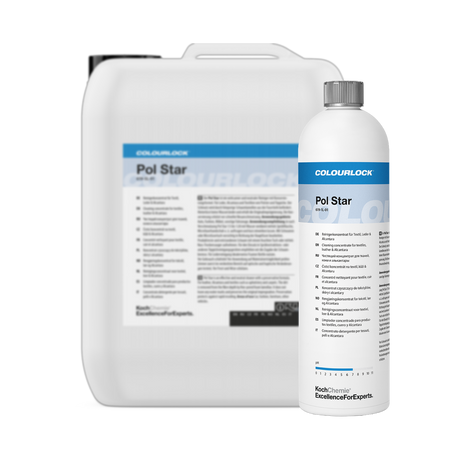
The COLOURLOCK Pol Star is the suitable pre-product: pH 7, dilutable 1:5 to 1:20, without acids or alkalis. For pigmented smooth leather, always use the weaker 1:20 dilution. Lightly mist from a pump sprayer, work in with a soft microfiber applicator, wipe off with a damp microfiber cloth — and then let the leather air dry for twenty to thirty minutes. Applying Leather Star to still damp leather blocks fiber penetration: the hydrophobic emulsion cannot penetrate a water-saturated fiber structure and remains on the surface as a streaky film.
On clean, dry leather, apply 15 to 20 pea-sized drops per seat cushion — onto the microfiber applicator, not directly onto the leather. Distribute evenly in circular motions, without going over the seat edges. A seat bolster needs less than a seat cushion, perforated leather less than smooth leather with a dense grain. For the center console and leather steering wheel, a single drop per component is sufficient. For pigmented aniline leather — common in BMW Individual, Bentley, or Rolls-Royce — work quickly, as the open-pore fiber absorbs the emulsion faster; uneven saturation otherwise creates toning spots.
After 5 to 10 minutes of dwell time, gently buff off the shine with a dry microfiber cloth — until the surface looks dull-matte and feels dry to the touch. Only then is the OEM look achieved. With normal car use, the care lasts three to six months; in summer with frequent UV exposure and bare legs on the driver's seat, the interval tends towards the lower end.
The temperature factor is often overlooked: leather care works best between 18 and 25 degrees Celsius, exactly within the May range of a workshop interior. In cool garage air below 12 degrees, the emulsion remains too viscous and penetrates unevenly; in bright midday sun above 28 degrees, it dries too quickly and leaves streaks. Those working in a carport or under a hall section already have ideal conditions on their side. We deliberately do not address home remedies myths surrounding olive oil, shoe polish, or baby lotion — cooking oils bind dust and turn rancid, shoe polish applies a pigmented layer to the coating, and baby lotion contains too much water and surfactants. The effort remains the same, but the risk of permanent stains drastically increases.

The Detailing1 Workflow for the May Routine
For the May leather care routine, a two-product setup is sufficient: a pH-neutral cleaner concentrate and a re-greasing emulsion with UV block. Both bestsellers are available with double-digit stock at Detailing1 and cover the care cycle of an average car for one to two years.
Step one is the COLOURLOCK Pol Star in the 1-liter variant as a cleaner concentrate. At a 1:10 dilution, one liter yields about eleven liters of ready-to-use solution — enough for several full interior cleanings and simultaneously for upholstery, carpet, and door panels. If you only want to clean the seat without considering the volume, take the 100ml variant as a compact seasonal starter.
Step two is the Koch-Chemie Leather Star "Ls" as a ready-to-use emulsion, applied drop by drop onto the microfiber applicator. A 1-liter bottle is sufficient for about 100 seat treatments with normal car use — for two convertible seats plus driver's and passenger's seats in a daily driver, this means four to five complete treatments per quarter over several years. Four verified reviews have full marks, with recurring comments emphasizing the matte finish and ease of application.
Those who want to combine both products in one order will find the complete Detailing1 assortment in the Leather Care category — sorted by application step from cleaner to care to seasonal impregnation.
For tools, three standard microfiber applicators and two dry microfiber cloths per car are sufficient. The applicators are for applying the care product, the cloths for buffing and the cleaner removal step. Those who care for their leather regularly keep a second set separate for the cockpit and door panels — seat leather and hard plastic are only briefly compatible on the same cloth, and over several seasons, a mixed cloth transfers pigments from one surface to another.
During the active convertible season, a care cycle every three months is recommended; for daily drivers with sports seats, one care treatment in spring and one in early autumn is sufficient.
Which care product suits which leather problem
Car leather care is an "if-then" decision. A dry, dull seat bolster after winter requires a different answer than light convertible leather before the summer season or a worn leather steering wheel with hand patina.
If your leather looks dull and faded in spring after six months of heated air, the Pol Star + Leather Star sequence is mandatory — in the form described above, with complete drying in between. Pure care without prior cleaning traps sweat and skin oils in the pores, a mistake that only becomes visible after weeks but then manifests permanently as a dirt ring on the seat bolster.
If your convertible comes out of winter storage, the UV block is the crucial factor. Light aniline leather visibly fades in a single summer season without an active block; with Leather Star and a second care treatment in July, the color remains stable for two seasons. For black leather in a convertible, UV exposure is optically less critical, but mechanically identical — the collagen fibers need re-greasing just as much.
If your leather steering wheel has become grippy-matte, a single drop of Leather Star on a cloth, work in thinly, let sit briefly, buff gently. That's all it is — the steering wheel is the most stressed leather surface in the car and tolerates short care every six to eight weeks. If your seat shows cracks or torn patent leather areas, the damage is beyond normal care; only a restoration workflow or a leather center can help there, not standard care.

Detailing1 Insight: The scent of fresh Leather Star is creamy-chemical and dissipates within about 48 hours. If you're taking passengers on the day of care, ventilate thoroughly beforehand or care for the car on the weekend with the doors open. For perforated seats with ventilation function, it's also important: only switch on the ventilation again the next morning — otherwise the seat ventilation will draw the scent into the upholstery filling, and it will remain noticeable there for much longer than the usual 48 hours. In the daily workshop routine at Detailing1, we always care for convertibles on Fridays, so the weekend serves as a silent ventilation window.
No time for the whole post? Get it summarized: