

Saharan Dust and Pollen – Your Paint is Under Double Stress
Your car is parked outside and looks like someone sprinkled flour over it. A yellowish-brown film on the paint, on the windows, in the door jambs. Your first instinct: grab a cloth and wipe it off. And exactly this instinct will cost you your clear coat.
What's happening right now is a rare double burden. Saharan dust from North Africa meets the strongest birch pollen flight of the year. Two substances that are problematic individually – and together, they chemically and mechanically attack your paint simultaneously. This article explains why this is more dangerous than normal dirt, how to avoid damage, and which products you need for it.
60 Percent Quartz – Why Saharan Dust Is Not Normal Dirt
Saharan dust consists of about 60 percent quartz, a mineral with a Mohs hardness of 7. For comparison: automotive clear coat has a hardness of 3 to 4 on the same scale. The particles are 10 to 100 micrometers small – invisible individually, but as a layer on the paint, they form a pervasive abrasive. In addition to quartz, the dust contains various salts and iron oxides, which give the mixture its characteristic yellowish-red color.
If you wipe it off dry, exactly what sandpaper with P1500 grit does happens: micro-scratches that dull the clear coat. Not immediately visible on a cloudy day, but in the next hour of sunshine, a network of fine scratches – so-called swirl marks. The ADAC explicitly warns: even a damp sponge is not enough because you drag the quartz grains across the paint when wiping, and they act like abrasives.
The crux: Saharan dust events primarily occur in Germany between March and June – statistically three to five episodes per year. This is precisely the phase when pollen count is at its peak. And pollen has a completely different damage profile, which makes things really complicated.
Another aspect many underestimate: Saharan dust binds to moisture. If rain falls after a dust event – the so-called blood rain – the mixture of mineral dust and rainwater dries into a cement-like crust on the paint. This crust is significantly harder to remove than dry dust and further increases the risk of scratches during washing.
Pollen Enzymes Eat Through Clear Coat in 48 Hours
Birch pollen, which is flying at record levels across Germany in April, does not damage the paint mechanically, but chemically. The pollen shell contains enzymes and organic acids that are activated upon contact with water and UV radiation. Above 15 °C ambient temperature and direct sun, a process begins that leaves visible etching marks in the clear coat within 24 to 48 hours.
The insidious thing: the pollen looks harmless – a yellow film that can be easily washed off, as long as you're quick. But if you wait three or four days in warm weather, the enzymes literally burn themselves in. The result is dull, slightly sunken spots in the clear coat, which can only be removed by machine polishing. For heavily affected areas – typically the hood and roof, which are parked directly under trees – polishing may require several passes.
Together with Saharan dust, a toxic combination arises: the quartz grains prevent rain from washing away the pollen because the mineral layer fixes the organic film to the paint. At the same time, the sticky pollen holds the Saharan dust, which would otherwise be partly carried away by the wind. Two layers that stabilize each other – chemically etching the paint from above and mechanically attacking it from below.
A detail that is missing in most guides: The combination of pollen and Saharan dust creates a particularly aggressive environment when it rains. The organic acids in the pollen dissolve minerals from the Saharan dust, which lowers the pH value of the liquid on the paint. This slightly acidic solution attacks unprotected clear coats faster than pure pollen moisture. Anyone who leaves their car in this condition for several days risks not only etching marks but also accelerated oxidation of the paint. Dark paints – black, dark blue, dark green – are particularly at risk because they absorb UV radiation more strongly, and thus the enzymatic reaction of the pollen proceeds faster.

Contactless Pre-wash – The Only Safe First Step
The most important rule for Saharan dust on the paint: no contact before the particles are dissolved. No sponge, no wash mitt, no microfiber cloth. The first step is always a contactless pre-wash, which removes coarse dirt from the paint without mechanical action. This principle is a basic rule in detailing but becomes an absolute must with Saharan dust.
Snow foam is the tool of choice for this. A PROFILINE ActiFoam Energy in the foam cannon creates a thick foam layer that adheres to the paint for 3 to 5 minutes and chemically penetrates the dust. The alkaline foam with a pH value around 10 dissolves both the mineral dust particles and the organic pollen film. It creeps under the quartz grains, breaks the bond to the paint, and allows the dirt to run off without contact when rinsed.
After that – and only then – comes the pressure washer. At least 30 centimeters distance, from top to bottom, so that the dissolved dust is rinsed downwards and does not get into areas you have already cleaned. Don't forget the wheel arches and sills – a lot of Saharan dust, which was thrown up while driving, accumulates here during rain.
Only when the surface is visually free of the dust layer are you allowed to start the main wash with the Koch-Chemie Exterior Wash Mitt and a pH-neutral GYEON Q²M Bathe car shampoo. The Wash Mitt with its 640 GSM absorbs residual particles without dragging them across the paint – provided you rinse it thoroughly in the wash bucket after each panel.
The Complete Workflow in 7 Steps
A structured process protects your paint most effectively. Here's the workflow we at Detailing1 recommend for the combination of Saharan dust and pollen infestation – from the rim to the last wipe.
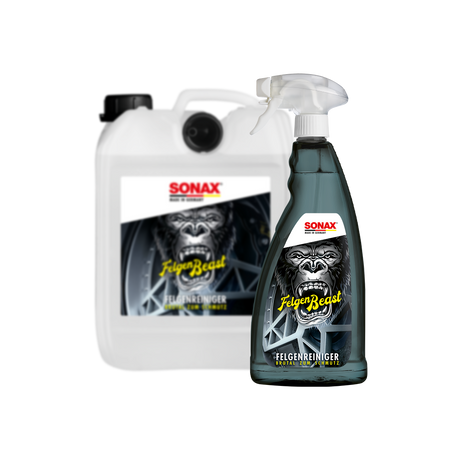
Step one: Wheels first. Spray SONAX FelgenBeast onto dry, cold rims, let it sit for 3 minutes, and rinse with the pressure washer. Saharan dust particularly settles in the spokes and behind the brake calipers. If you wash the bodywork first and then tackle the rims, the rim dirt will splash onto the clean paint.
Step two: Apply snow foam to the entire bodywork, including wheel arches and sills. Allow 3 to 5 minutes to dwell – do not let it dry. In direct sunlight, move the vehicle into the shade beforehand or wet the surface with clear water. The foam must remain moist so that it keeps the particles in suspension.
Step three: Rinse thoroughly with the pressure washer, from top to bottom, covering all edges and seams. Step four: Main wash with the two-bucket method – one bucket with shampoo solution, one bucket with clear rinse water and a grit guard at the bottom. Wash out the wash mitt in the rinse bucket after each panel before it goes back into the shampoo solution. This prevents you from dragging quartz grains from the roof over the hood.
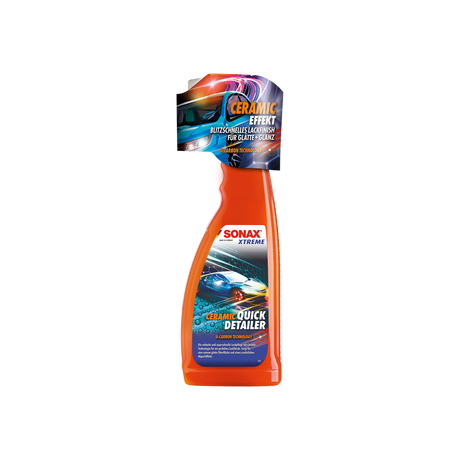
Step five: Final rinse from top to bottom, letting the water jet flow flat over the surface – the so-called sheeting. The water forms a film that carries away residual dirt and dries faster than individual drops. Step six: Wipe door jambs, fuel cap, and trunk edges with a separate, well-moistened microfiber cloth – a lot of dust collects here, which will trickle onto the freshly washed paint during the next drive. Step seven: Dry with a clean drying towel and, in the same step, apply a quick detailer like the SONAX XTREME Ceramic QuickDetailer. This immediately seals the freshly cleaned surface and gives you hydrophobic protection for the next few days, significantly reducing new dust and pollen accumulation.

Five Mistakes That Double the Damage
Mistake number one is dry wiping – the sandpaper effect, which SONAX also identifies as the biggest risk with Saharan dust in their care instructions. Every dry wipe creates hundreds of micro-scratches that only disappear with machine polishing. This also applies to seemingly soft microfiber cloths: without lubricant, they are just as damaging as a cotton rag when in contact with quartz.
Mistake two: Operating the windshield wipers on a dusty windshield. The wiper blades push the quartz grains across the glass, creating streaks that severely impair visibility in oncoming light. The correct sequence: First activate the windshield washer system, wait 10 seconds for the water to dissolve the dust, then wipe. Even better: spray the windshield manually with a pressure washer before driving off.
Mistake three: Using hot water. Temperatures above 40 °C can activate pollen enzymes faster and simultaneously dissolve existing wax or sealant layers. Lukewarm water between 20 and 30 °C is ideal – warm enough to dissolve dirt, cool enough to preserve paint protection. Boiling water, as sometimes recommended in forums, is a sure way to destroy the sealant.
Mistake four: Forgetting the rims. Brake dust and Saharan dust together form a particularly aggressive mixture because the iron particles in brake dust react with the minerals in desert sand and accelerate corrosion on aluminum rims. Anyone who only washes the bodywork and ignores the rims will have baked-on stains after two weeks that a normal rim cleaner can no longer remove.
Mistake five: Not applying anything after washing. An unsealed paint has a rough surface at a micro-level – pollen and dust adhere significantly faster there than on a hydrophobic layer. The 90 seconds for a quick detailer after each wash are the best investment for the next clean days, especially during the season from March to June.
Sealing, Pollen Filters, Timing – How Your Paint Survives the Season
The next Saharan dust event is coming – the question is not if, but when. Prevention is easier than cure, and the most important measure is an intact surface sealant. A spray sealant or a ceramic coating measurably reduces particle adhesion because the smooth, hydrophobic surface offers less area for attack. Saharan dust beads off much more easily during the next pre-wash than on unprotected clear coat.
For the interior: check the pollen filter. Older vehicles often only have a simple particle filter that does not completely retain Saharan dust. An activated carbon combination filter filters both fine dust and pollen and odors. The change usually costs less than 30 euros and 15 minutes of work – and prevents desert dust from entering the interior via the ventilation and settling on the dashboard, displays, and upholstery.
If you have a garage or carport: use it. Sounds obvious but is often forgotten when the car is "just briefly" outside. During an active Saharan dust event, 6 to 12 hours are enough for a visible layer of dust. And if you don't have a cover, you should wash between two rainy days – the rain washes off some of the dust, but leaves water spots and mineral residues when drying, which won't come off cleanly without shampoo.
In the long term, it's worth looking at spray sealants. A quick detailer after each wash – consistently applied from March to June – significantly reduces the effort per Saharan dust episode because the dust simply adheres less. This is not a luxury, but a time-saver: a sealed surface often only needs a snow foam pre-wash and a quick rinse instead of the complete 7-step workflow.
And a final point that rarely appears in guides: the rims also benefit from a sealant. Brake dust and Saharan dust together are more aggressive than any substance alone. A sealed rim can often be cleaned contact-free with the snow foam pre-wash – without a separate rim cleaner, without chemicals, without risk. Anyone who consistently works according to this principle in April and May – pre-wash, gentle main wash, sealant as a finish – not only protects their paint from the current event but builds a protective shield that makes the entire pollen season much more relaxed.